
Salem Witch Trials
Martha Carrier: Condemned as the Queen of Hell
By Lori, History writer & tour co-founder • October 2026 • 10 min read
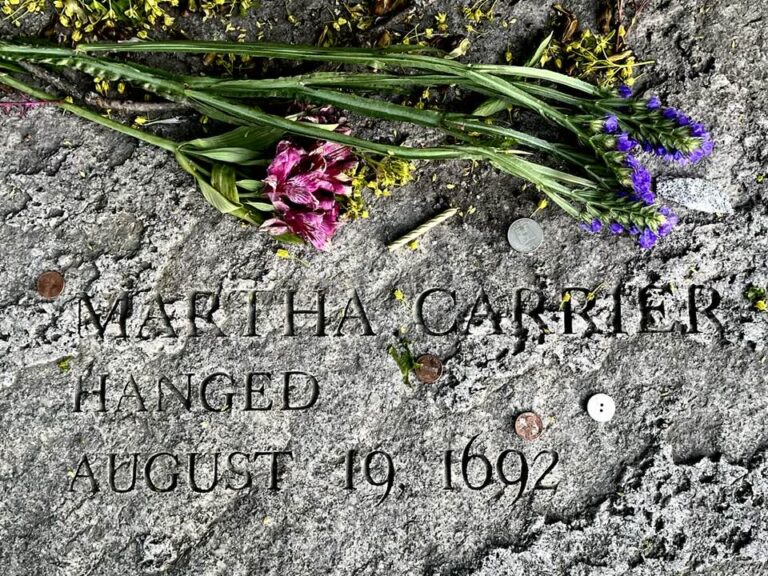
Most of the accused pleaded with the court and insisted they were innocent. Martha Carrier did something far more dangerous: she looked the court in the eye and called the whole thing a fraud. When the afflicted girls convulsed at her feet, she told the judges they were simply “out of their wits.” For that defiance, and for being a poor outsider a town had already decided to hate, she was branded the “Queen of Hell” and sent to the gallows.
Martha Carrier’s story is one of the fiercest and most disturbing of 1692, and one we tell with real admiration on our Salem Witch Trials walking tour. It’s also where the darkest truth of the trials comes into focus: this was a machine that ran on fear, scapegoating, and torture.
Martha Carrier AT A GLANCE
WHO – A sharp-tongued, strong-willed woman from Andover, Massachusetts
ACCUSED – May 1692, after her family was blamed for an Andover smallpox outbreak
INFAMOUS AS – The “Queen of Hell,” a label pushed by minister Cotton Mather
THE CRUELTY – Her teenage sons were tortured into confessing; her young children were coerced to testify against her
EXECUTED – Hanged at Proctor’s Ledge, August 19, 1692
An outsider from the beginning
Martha Allen was born in Andover sometime in the 1640s. In 1674 she married Thomas Carrier, a Welsh indentured servant, and their first child arrived just two months later, a scandal in Puritan New England. The couple raised a large family and moved between towns, and more than once they found themselves unwelcome. In Billerica, the selectmen reportedly told the Carriers to leave or pay a weekly surety to stay, apparently out of fear they might spread smallpox. Martha Carrier was the kind of person a community kept at arm’s length, poor, blunt, and unafraid to speak her mind.
Blamed for an epidemic
The seed of her destruction was planted in 1690, when a smallpox outbreak struck Andover. Martha and several of her children fell ill, and the town’s officials pointed the finger squarely at the Carriers, accusing them of bringing the disease and refusing to care for them. More than a dozen people died in that outbreak, including six members of Martha’s own Allen family. The town’s resentment of the “disease-bringing” Carriers didn’t fade. Two years later, it would resurface in the language of witchcraft.
“You lie, I am wronged”
On May 28, 1692, a complaint was filed against Martha Carrier, and she was arrested that day. At her examination on May 31, at Ingersoll’s Tavern, the afflicted girls put on their usual performance, crying out that she pinched and choked them and pushed the devil’s book at them. Then they accused her of having killed thirteen people in Andover, almost certainly a reference to the smallpox dead the town had always blamed on her family.
Where others crumbled, Martha fought. She dismissed the girls to the judges’ faces:
“It is a shameful thing that you should mind these folks that are out of their wits.”
— Martha Carrier at her examination, from the court record, May 1692
When the girls shrieked that they could see the ghosts of her victims in the room, she snapped back, “You lie, I am wronged.” It was exactly the kind of courage the court could not tolerate. The judges ordered her hands and feet bound with rope, and the transcriber, likely Reverend Samuel Parris, noted with chilling satisfaction that the moment she was tied, “they all had strange & sudden ease.” She was indicted and sent back to jail.
The Andover panic
Martha’s arrest helped unleash a second wave of hysteria in her own town. A confession by an elderly Andover widow, Ann Foster, spiraled into wild claims that Martha had flown with her on a stick to witch meetings, that there were hundreds of witches in the country, that the devil meant to build his kingdom in Salem Village. Foster’s confession did for Andover what Tituba’s had done for Salem: it opened the floodgates. Soon one accuser claimed Martha had boasted that the devil promised she would be “a queen in hell.” The phrase stuck, and it would define her forever.
The torture of her sons
What came next is one of the most shameful episodes of the entire trials. Martha’s teenage sons, Richard and Andrew Carrier, were arrested and questioned. At first they denied everything. So the court took them out of the room, bound them hand and foot, and, according to a letter write by fellow prisoner John Proctor, tortured them until they confessed:
“Young men, who would not confess any thing till they tied them neck and heels till the blood was ready to come out of their noses.”
— John Proctor’s jailhouse letter, describing the torture of the Carrier sons, 1692
Broken, the boys confessed to witchcraft and named their own mother. Proctor’s letter is one of the clearest surviving proofs that the Salem confessions were often forced, not freely given, but beaten out of frightened people.
Her own children made to testify
The cruelty reached even further. Martha’s younger children were dragged into it too: her ten-year-old son Thomas and eight-year-old daughter Sarah were arrested and examined, and both were made to “confess” that their mother had baptized them into witchcraft and taught them to afflict people. Imagine a mother in a cell, learning that her small children had been frightened into testifying that she had made them witches. No invented ghost story in Salem is more horrifying than that real one.
A trial of grudges and ailments
Martha Carrier’s trial opened on August 2, 1692. As in so many cases, the “evidence” was a heap of old quarrels suddenly blamed on witchcraft, especially from neighbors she’d argued with:
- A neighbor said that after a dispute, his pigs died or vanished, and his cow went dry.
- A man who’d clashed with her over land claimed he developed a terrible festering sore that healed only after her arrest.
- Others blamed dead cattle, a slow-healing war wound, and sudden pains on her anger.
Not one piece of it was evidence of witchcraft, only of a hard woman with enemies. On August 5, the jury found her guilty and sentenced her to death.
HOW A VICTIM BECAME A “QUEEN”
The making of a villain
When the minister Cotton Mather later wrote his account of the trials, he singled Martha Carrier out with venom, calling her a “rampant hag” and repeating that the devil had promised she would be Queen of Hell. It’s a stark reminder that the people who ran and defended the trials needed their victims to be monsters. The truth was smaller and sadder: Martha Carrier was a poor, plain-spoken woman her town had blamed for a plague, and who refused, right to the end, to pretend otherwise.
August 19, 1692
On August 19, 1692, Martha Carrier was carried by cart to Proctor’s Ledge and hanged alongside four men: Reverend George Burroughs, John Proctor, John Willard, and George Jacobs Sr. In his diary that day, Judge Samuel Sewall recorded that every one of them insisted on their innocence, “Carrier and all.” To the last breath, she never gave her accusers the confession they wanted.
WALK HER STORY
Hear Martha Carrier's story where it happened
Our historian-led 1692 Salem Historical Tour tells the true stories of Martha Carrier and the other victims on the very streets where the trials unfolded. Two hours, all ages, $35 adults / $10 kids.
Frequently asked questions
Martha Carrier was a strong-willed woman from Andover, Massachusetts, and one of the twenty people executed during the 1692 Salem Witch Trials. Known for her sharp tongue and defiance, she was hanged on August 19, 1692, after refusing to confess.
During the trials, a confessor claimed Martha Carrier had said the devil promised she would be “a queen in hell.” The minister Cotton Mather seized on the phrase in his writings, calling her a “rampant hag” and casting her as the devil’s queen. The label was propaganda meant to justify her execution, not a reflection of who she really was.
Martha Carrier was an outspoken, poor outsider whose family had been blamed for bringing a deadly smallpox outbreak to Andover in 1690. That resentment, combined with personal grudges over land and livestock, resurfaced as witchcraft accusations in 1692 — including the claim that she had killed thirteen people, which likely referred to the smallpox dead.
Martha’s teenage sons, Richard and Andrew, were tortured — bound hand and foot until they bled — until they confessed to witchcraft and named their mother. Her younger children, ten-year-old Thomas and eight-year-old Sarah, were also arrested and coerced into testifying that she had made them witches.
Martha Carrier was found guilty on August 5, 1692, and hanged on August 19, 1692, at Proctor’s Ledge in Salem, alongside George Burroughs, John Proctor, John Willard, and George Jacobs Sr. She maintained her innocence to the end.
- Login
- Sign Up