Salem Witch Trials
The Judges of the Salem Witch Trials: The Men Who Held the Power of Life and Death
By Lori, History writer & tour co-founder • October 2026 • 11 min read
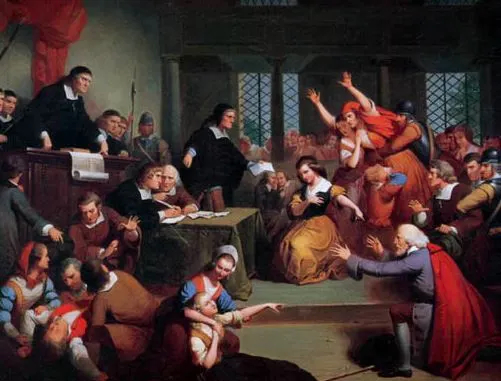
We spend a great deal of time remembering the twenty people who were executed in 1692, and rightly so. But the trials didn’t happen on their own. A small group of men decided which accusations to believe, which evidence to allow, and which neighbors would hang. They were the colony’s elite: wealthy merchants, militia colonels, Harvard men, and close friends. And when it was all over, only a single one of them ever stood up and admitted he had been wrong.
On our Salem Witch Trials walking tour, people always ask the same question about the judges: how could educated, respected men let this happen? Here’s who they actually were.
THE JUDGES AT A GLANCE
THE COURT – The Court of Oyer and Terminer, created by Governor William Phips on May 27, 1692
THE JUDGES – Nine magistrates — all wealthy, powerful members of the Governor’s Council; six of the nine were related by marriage
CHIEF JUSTICE – William Stoughton, who allowed the deadly “spectral evidence” and never expressed regret
THE ONE WHO QUIT – Nathaniel Saltonstall resigned within weeks, “dissatisfied with the proceedings”
THE ONE WHO APOLOGIZED – Samuel Sewall, the only judge who publicly repented, in 1697
A court built in a hurry
By the spring of 1692, the Salem jails were overflowing with accused witches, and there was no proper court to try them. Massachusetts had been operating without a legal charter for years, and the new governor, Sir William Phips, had only just arrived. On May 27, 1692, Phips created a special court to clear the backlog: the Court of Oyer and Terminer, an old legal term meaning “to hear and determine.” He appointed nine magistrates to it.
Phips later wrote that he had chosen “persons of the best prudence and figure that could then be pitched upon“, in other words, the most respected men he could find. On paper, they were an impressive bench. In practice, they would preside over the deaths of twenty people in just a few months.
Who were these men?
The judges of Salem were not backwoods fanatics. They were the colony’s ruling class. Nearly all of them were wealthy merchants and high-ranking militia officers; all were experienced magistrates; and all sat on the Governor’s Council, the most powerful body in Massachusetts. Five had attended Harvard, which at the time mainly trained ministers, though none actually became one.
But the single most important thing to understand about this bench is how closely its members were bound to one another. Historian Emerson W. Baker has described them as the heart of the colony’s elite, and six of the nine judges were related by marriage. This was not a panel of impartial strangers weighing evidence at arm’s length. It was a tight web of in-laws and relations, sitting together in judgment of their neighbors.
Six of the nine judges were related by marriage. This was not a jury of strangers — it was a family of the powerful.
A BENCH BOUND BY MARRIAGE
How the nine were tied together
The marriage ties ran straight through the court. Judge Peter Sergeant married into the family of Salem judge Jonathan Corwin, and also married a relation of Governor Phips himself, the very man who had appointed them all. Judge John Richards wed Ann Winthrop in the middle of the trials, binding him to the family of fellow judge Waitstill Winthrop; the ceremony was performed by chief justice William Stoughton, with many of the other judges in attendance as guests.
The connections reached the men who carried out the sentences, too. Judge Bartholomew Gedney’s daughter Lydia was married to George Corwin, the county sheriff who hanged the condemned and seized their property, and who happened to be judge Jonathan Corwin’s own nephew. In other words, the men deciding the cases, the man enforcing the verdicts, and the governor who created the court were, in many instances, one extended family.
They were close in age as well as blood. The youngest, Samuel Sewall, was 40; the oldest, John Richards, was 67. Most were somewhere in their late forties and early fifties, established men at the peak of their influence, judging the people they had lived among for decades.
William Stoughton: the chief justice who never looked back
If any single man bears the heaviest responsibility, it is William Stoughton. Born in 1631 and educated at Harvard and Oxford, he had trained as a clergyman before building a long career in colonial government. In May 1692 he was made Lieutenant Governor, and days later Phips named him chief magistrate of the new court.
Stoughton is widely blamed for the court’s most fatal decision: allowing spectral evidence, testimony that an accuser had seen the ghost or specter of the defendant tormenting them. Because a specter could not be cross-examined or disproven, it was impossible to defend against. It sent person after person to the gallows. When Phips finally barred spectral evidence that fall, the convictions collapsed almost overnight.
And yet Stoughton never wavered. He went on to become the first Chief Justice of the new Superior Court and served as acting governor of Massachusetts until his death in 1701. Of all the judges, he is the one who, as far as the record shows, never expressed a word of regret.
Hathorne & Corwin: the faces of the examinations
Before anyone reached a formal trial, they first faced a pre-trial examination, and in Salem, two local men ran those rooms: John Hathorne and Jonathan Corwin, both Salem-born merchants and magistrates.
Hathorne became the chief examiner, and his style set the tone for everything that followed. He didn’t question the accused so much as prosecute them, treating guilt as a foregone conclusion and demanding to know not whether they practiced witchcraft but why. Corwin sat alongside him and later joined the main court, replacing a judge who had quit. Neither man is recorded as ever apologizing.
A FAMOUS DESCENDANT
The judge who haunted a novelist
John Hathorne’s most famous descendant was the author Nathaniel Hawthorne, who wrote The Scarlet Letter and The House of the Seven Gables. Ashamed of his ancestor’s role in the trials, Hawthorne is believed to have added the “w” to his surname to distance himself from the unrepentant judge. The guilt of 1692 echoed through his family for more than a century.
Nathaniel Saltonstall: the judge who walked away
Not every judge went along with it. Nathaniel Saltonstall, a Harvard-educated major from Haverhill, was appointed to the court in May, and resigned within a matter of weeks. By the accounts that survive, he was “very much dissatisfied with the proceedings” he had witnessed, almost certainly including the court’s reliance on spectral evidence and the first execution.
His departure is a quiet but important fact. It proves that a reasonable, informed man of that exact time and place could look at what the court was doing and conclude it was wrong. The horror of Salem was not inevitable. At least one of the nine saw it clearly, and refused to be part of it.
Samuel Sewall: the only one who said he was sorry
The most remarkable story belongs to Samuel Sewall, the youngest judge on the bench. A Harvard graduate and a diarist whose journals survive to this day, Sewall sat through the trials like the others and signed off on the deaths.
But unlike the others, he could not live with it. On a public fast day in January 1697, a day set aside by the colony to atone for the tragedy, Sewall stood in Boston’s Old South Church while his minister read aloud a statement in which Sewall took the “blame and shame” of the trials upon himself and asked for the forgiveness of God and of the community. He was the only one of the Salem judges ever to publicly apologize.
For the rest of his life, Sewall kept a private day of fasting and repentance every year. He also went on to write one of the earliest anti-slavery tracts in the colonies. He died in 1730, having spent more than three decades trying to make right the one year he could never undo.
Nine men signed the death warrants. One of them spent the rest of his life asking to be forgiven for it.
The rest of the bench
The remaining judges were cut from the same cloth, powerful, connected, and sure of themselves:
- Bartholomew Gedney – a Salem physician, merchant, and militia colonel who sat at several examinations. His daughter married George Corwin, the sheriff who carried out the executions and seized the victims’ property.
- John Richards – a Boston merchant and militia major, and the oldest judge at 67. He actually married during the trials, in a ceremony officiated by Stoughton and attended by many of his fellow judges.
- Thomas Danforth – the deputy governor, who presided over examinations but did not sit on the Court of Oyer and Terminer. He later joined the court that replaced it.
- Peter Sergeant – a wealthy Boston merchant and long-serving councilor, whose grand mansion later became the official governor’s residence.
- Waitstill Winthrop – grandson of one Massachusetts governor and son of a Connecticut governor, and commander in chief of the colony’s militia.
How the court ended
By the autumn of 1692, the tide had turned. Prominent ministers, including Increase Mather, had begun to argue that spectral evidence was unreliable, and that it was better for a guilty witch to go free than for an innocent person to be condemned. But several forces pushed Governor Phips to act, and one of them struck remarkably close to home.
By late September, the accusations had spiraled so far out of control that they reached Phips’s own household: on September 29, 1692, his wife, Lady Mary Phips, was herself named as a witch. When the hysteria threatened the governor’s own family, the danger of letting it run unchecked became impossible to ignore. Phips intervened. On October 29, 1692, he formally forbade the use of spectral evidence, and shortly afterward he dissolved the Court of Oyer and Terminer altogether.
A new court, the Superior Court of Judicature, was established on November 25, 1692, to hear the remaining cases. Five of the original judges carried over to it, and without spectral evidence, nearly all of the remaining accused were found not guilty or reprieved. The machinery that had killed twenty people simply stopped working once the rules were changed. It is one of history’s clearest lessons in how much depends not on the accusations themselves, but on who decides what counts as proof.
WALK THE REAL HISTORY
Stand where the judges sat
Our historian-led 1692 Salem Historical Tour walks you through the real courtrooms, accusations, and decisions that shaped the trials, the judges, the accused, and the town caught in between. Two hours, all ages, $35 adults / $10 kids.
Frequently asked questions
The main trials were held before the Court of Oyer and Terminer, created by Governor William Phips in May 1692. Its nine judges were William Stoughton (chief justice), John Richards, Nathaniel Saltonstall, Bartholomew Gedney, John Hathorne, Jonathan Corwin, Peter Sergeant, Samuel Sewall, and Waitstill Winthrop. Thomas Danforth also presided over pre-trial examinations. They were wealthy merchants, militia officers, and members of the Governor’s Council.
William Stoughton served as chief magistrate of the Court of Oyer and Terminer and later as the first Chief Justice of the Superior Court of Judicature. He is widely held responsible for allowing spectral evidence, and he never expressed any regret for his role in the trials.
Only one. Judge Samuel Sewall publicly apologized in January 1697, standing in church while a statement was read in which he took the “blame and shame” of the trials upon himself. He was the only one of the Salem judges ever to publicly repent. Nathaniel Saltonstall also resigned from the court early, dissatisfied with the proceedings, though he did not issue a formal apology.
Spectral evidence was testimony in which an accuser claimed to have seen the ghost or “specter” of the defendant tormenting them. Because a specter could not be seen by others or cross-examined, it was almost impossible to disprove, which made it extraordinarily dangerous. When Governor Phips barred spectral evidence in late 1692, convictions collapsed and the trials effectively ended.
Yes. Judge John Hathorne was an ancestor of the novelist Nathaniel Hawthorne, author of The Scarlet Letter. Hawthorne is believed to have added the “w” to his last name to distance himself from the judge, whose role in the trials he found shameful.
Sources & further reading
This article draws on the original 1692 court records and firsthand accounts. To read the primary sources yourself:
- About the Supreme Judicial Court – Mass.gov
- A Storm of Witchcraft: The Salem Trials and the American Experience- Emerson Baker
- The Salem Witch Trials Documentary Archive and Transcription Project — the full collection of original court records and transcriptions from 1692.