Sites & Memorials
Where Are the 20 Victims of the Salem Witch Trials Buried?
By Lori, History writer & tour co-founder • Updated September 2026 • 7 min read
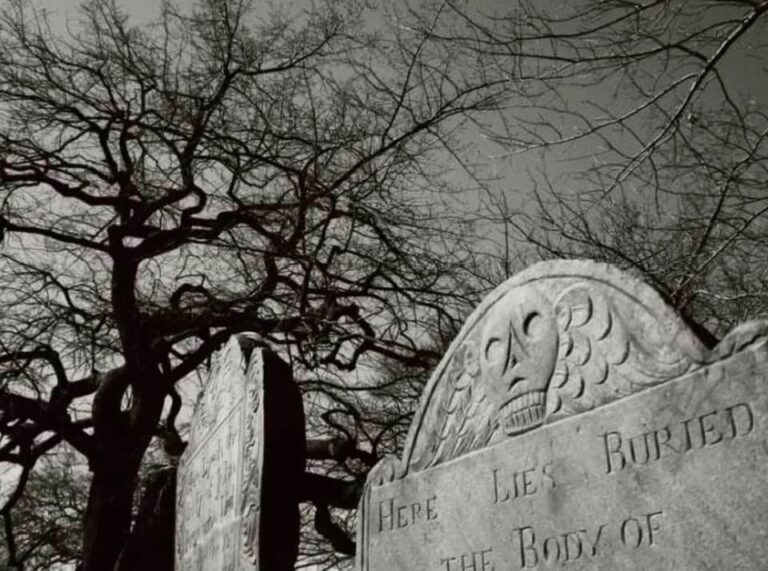
Twenty innocent people were executed in Salem in 1692. So here’s a question that has haunted visitors for more than three centuries: where are they buried? The unsettling answer is that, for most of them, we simply don’t know, and the reason why says everything about how they were treated.
People who take our Salem Witch Trials walking tour ask about this more than almost anything else. There’s no rows of gravestones, no family plot, no marked resting place for most of the accused. To understand why, you have to start at the place where they died.
The Short Answer
- The nineteen who were hanged died at Proctor’s Ledge, confirmed by researchers in 2016.
- As convicted “witches,” they were denied a Christian burial and left in shallow graves.
- Some families secretly recovered their dead at night and buried them on private land.
- Only two graves can be traced today — Rebecca Nurse and George Jacobs Sr., both at the Rebecca Nurse Homestead in Danvers.
- The Salem Witch Trials Memorial (1992) honors all twenty, but no victims are buried there.
Ground zero: Proctor's Ledge
For years, no one could say exactly where the hangings took place. Then, in January 2016, scholars working with the University of Virginia confirmed the execution site: a rocky rise called Proctor’s Ledge, at the base of what locals had long called Gallows Hill. On July 19, 2017, the 325th anniversary of the first mass execution, the City of Salem dedicated a quiet memorial there.
It’s a modest spot. But standing at the foot of that ledge, knowing nineteen people were hanged just above, is one of the most sobering moments in all of Salem.
Why the accused have no marked graves
The absence of graves shocks almost everyone, but in 1692 it was deliberate. Convicted witches were not permitted a proper Christian burial in the town’s cemeteries. According to eyewitness accounts, the nineteen who were hanged were left in shallow graves at Proctor’s Ledge. In some cases the graves were so shallow that, disturbingly, remains were left partly exposed.
What happened next is one of the few tender details in this whole grim story. Under cover of darkness, some victims’ families came to the ledge and quietly carried their loved ones home, burying them in secret, unmarked graves on their own property, a final act of dignity for people the law had denied it. Because those graves were hidden on purpose, most were lost to history.
The two victims we can still find
Out of twenty, only two graves can be traced with any confidence today, and remarkably, both now rest in the same place.
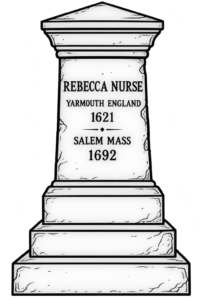
Rebecca Nurse
Hanged July 19, 1692
A respected 71-year-old grandmother from Salem Village (now Danvers). After her execution, her husband and son retrieved her body and buried her secretly on the family land. That land survives as the Rebecca Nurse Homestead at 149 Pine St. 25+ of the family’s original 300 acres, with the 1678 house, a reproduction 1672 Meeting House, and the Nurse-family cemetery. It’s a museum today, open May through early November.
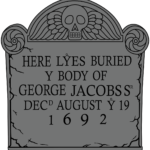
George Jacobs Sr.
Hanged August 19, 1692
A tall, white-haired farmer whose land lay in what is now Danvers. His family buried him on his property, marking the grave with two plain stones. In 1864, the Fowler family uncovered the remains of a tall, toothless man beneath two old stones — almost certainly Jacobs. After decades in storage, he was finally reburied at the Rebecca Nurse Homestead in 1992.
“Well, burn me or hang me, I will stand in the truth of Christ.”
— George Jacobs Sr., from his examination
The Salem Witch Trials Memorial
In 1992, on the 300th anniversary of the trials, the city unveiled the Salem Witch Trials Memorial beside the Old Burying Point (also called Charter Street Cemetery). It’s made of twenty stone benches, each carved with a victim’s name and the date they were executed. No one is buried beneath them. The memorial is a place of remembrance, not a grave, but it’s where their names finally stand together, in stone, refusing to be forgotten.
The Old Burying Point — where the judges lie
Next to the memorial sits the Old Burying Point, opened in 1637 and one of the oldest cemeteries in the United States. None of the executed are buried here. But several figures from the other side of the trials are:
- Judge John Hathorne — the relentless examining magistrate
- Judge Bartholomew Gedney — another of the trial judges
- Reverend Nicholas Noyes — believed buried in the governor’s tomb
- Samuel Shattuck — who testified against Bridget Bishop
There’s a quiet, terrible irony in the geography: the judged and the judges, separated by a single low wall. Stand between the memorial and the cemetery and you feel it.
The victims were denied graves. Their judges got tombs. The wall between them is only a few feet wide.
Why it still matters
Finding and honoring the twenty isn’t just an academic exercise; it’s a way of returning the dignity that 1692 tried to erase. Proctor’s Ledge, the memorial, and the graves in Danvers together let Salem face its darkest chapter honestly and turn it into something worth learning from: a warning about fear, rumor, and how quickly a community can turn on its own.
STAND WHERE IT HAPPENED
Visit the memorials with a historian
Our 1692 Salem Historical Tour walks you to the Witch Trials Memorial and the Old Burying Point, telling the true stories of the twenty who died — on the very ground where the history unfolded. Two hours, all ages, $35 adults / $10 kids.
Frequently asked questions
Most were left in shallow graves at Proctor’s Ledge, where they were hanged, because convicted witches were denied a Christian burial in Salem. Some families secretly recovered their loved ones at night and buried them in unmarked graves on private land, so most burial sites remain unknown today.
The nineteen people who were hanged during the 1692 Salem Witch Trials died at Proctor’s Ledge, at the base of Gallows Hill in Salem, Massachusetts. Researchers working with the University of Virginia confirmed the exact site in 2016, and a memorial was dedicated there in 2017.
Only two of the twenty victims can be traced: Rebecca Nurse and George Jacobs Sr. Both now rest at the Rebecca Nurse Homestead in Danvers, Massachusetts, which is open to visitors from May through early November.
No. The Salem Witch Trials Memorial, built in 1992, is a place of remembrance, not a burial ground. Its twenty stone benches carry each victim’s name and execution date, but no one is buried beneath them. The adjacent Old Burying Point holds several of the trial judges.
The main Salem Witch Trials Memorial was unveiled in 1992, on the 300th anniversary of the trials. A separate memorial at the Proctor’s Ledge execution site was dedicated in 2017. There is also a memorial in Danvers MA which was originally Salem Village. That memorial was also built in 1992.
Sources & further reading
The facts in this article are drawn from the original 1692 court records, examinations, and legal documents – no folklore. If you’d like to read the primary sources yourself, the best archive is:
- The Salem Witch Trials Documentary Archive and Transcription Project– University of Virginia. A searchable collection of the original court records, transcriptions, and documents from the 1692 trials.
- The Rebecca Nurse Homestead, Danvers, MA — the surviving site where both Rebecca Nurse and George Jacobs Sr. are buried.