Salem Witch Trials
Giles Corey and the Two Words that Made Him a Legend
By Lori, History writer & tour co-founder • Updated September 2026 • 7 min read

He could have saved himself with a single word. Instead, as the stones piled onto his chest, an eighty-year-old farmer looked up at the sheriff and said: “More weight.” Giles Corey is the only person in American history ever pressed to death, and the way he died turned him into a lasting symbol of defiance.
His story is one of the most unforgettable stories we tell on our Salem Witch Trials walking tour. But Giles Corey was no simple martyr. He was a complicated, sometimes violent man, which makes his final act of courage all the more striking.
GILES COREY AT A GLANCE
WHO – A prosperous Salem farmer, born in England around 1611.
ACCUSED – Of witchcraft in April 1692, after neighbors claimed to see his specter.
HOW HE DIED – Pressed to death under stones, September 19, 1692
WHY – He refused to enter a plea, standing “mute” to defy the court
FAMOUS WORDS – “more weight.”
From England to New England
Giles Corey was born in England around 1611 and immigrated to Massachusetts, where he built a sizable farm and a long, turbulent life. He married his first wife, Margaret, in the 1640s; together they had four daughters before her death in 1664. His second wife, Mary Britz, was his partner for twenty years until she passed in 1684. She lies today in Salem’s Old Burying Point. By 1692, Corey was an old man by colonial standards, prosperous and well established, but not without a dark reputation.
A violent reputation
Corey was no stranger to trouble. In 1675, he was tried in connection with the death of a farmhand named Jacob Goodale. A witness, Elisha Kebee, testified that Corey had beaten the young man roughly a hundred times with a stick about an inch thick. Corey later claimed Jacob had simply fallen and asked a neighbor to carry him to town for care; Jacob died days afterward. Corey was only fined for his part in the death.
It’s an ugly chapter, and we don’t skip it. The man who would become a symbol of courage in 1692 was, seventeen years earlier, something much less admirable. History is rarely tidy.
Martha, and the start of the hysteria
In 1690, Giles married his third wife, Martha Rich. Devout and outspoken, Martha was admitted to the Salem church as a full member and described herself as a “Gospel Woman.” Giles joined the Salem Town church in 1691, and together they worshipped in Salem Village under Reverend Samuel Parris.
When the first witchcraft arrests came on February 29, 1692, Martha thought the whole affair was nonsense. Giles, on the other hand, was fascinated. When he announced he wanted to attend the examinations, Martha was so opposed that she reportedly pulled the saddle off his horse to stop him. He went anyway. It was a decision that would cost them both their lives.
When the accusers turned on his wife
On March 12, 1692, the afflicted girls accused their first church member. Martha was arrested on March 21 and examined. At first, unsettled by the strange happenings at home, Giles wondered aloud whether his own wife might be responsible. But he quickly turned, denying the charges against her and openly defending her. That defense marked him. In the logic of the panic, anyone who stood up for the accused was halfway to being accused themselves.
Accused and arrested
On April 18, 1692, a complaint was filed against Giles after his neighbors Benjamin Gould and Mary Wolcott claimed to have seen his specter. He was arrested the next day. Months later, on September 9, he was brought before the court to be arraigned on charges of witchcraft.
And then Giles Corey did something no one expected. When the court asked him to enter his plea, he said nothing at all.
Why he refused to speak
Corey stood “mute,” refusing to plead guilty or not guilty. It was not confusion. It was strategy. He had already declared his innocence back in April, and he understood the trap: if he pleaded and was convicted, a near certainty in that court, the colony could seize his estate, leaving his heirs with nothing. By refusing to enter a plea, he denied the court the trial it needed. It was defiance with a purpose.
THE LAW USED AGAINST HIM
Peine forte et dure
English law had one answer for a prisoner who refused to plead, “strong and hard punishment.” The accused was laid on his back and loaded with as much weight as he could bear “and more,” given only scraps of bread and sips of water, until he either entered a plea or died. It was designed to force a plea. Giles Corey never gave one.
“More weight”
Giles was taken to a field beside the old Salem jail. There, on soft ground, a board was laid across his body and stones were stacked upon it, one after another. According to the accounts handed down, Sheriff George Corwin asked him again and again to enter his plea. Corey’s answer never changed. Legend holds that he cursed the sheriff and the town of Salem. Then, with what breath he had left, asked only for more weight.
“More weight.”
— Giles Corey’s reported final words, September 19, 1692
Even Salem’s own officials recorded the horror of it. Judge Samuel Sewall, who would later become the only magistrate to publicly repent of the trials, wrote in his diary:
“About noon, at Salem, Giles Corey was pressed to death for standing mute; much pain was used with him today, one after another, but all in vain.”
— Diary of Samuel Sewall, September 19, 1692
The legend and the legacy
In the centuries since, Giles Corey has become something larger than the difficult man he was in life. His refusal to plead is remembered as a stand against a court that had abandoned justice. A man who would rather be crushed than legitimize the proceedings that were killing his neighbors. Salem lore even insists his dying curse still lingers, blamed for misfortunes that befell the town’s sheriffs for generations. True or not, the story endures because the courage behind it was real.
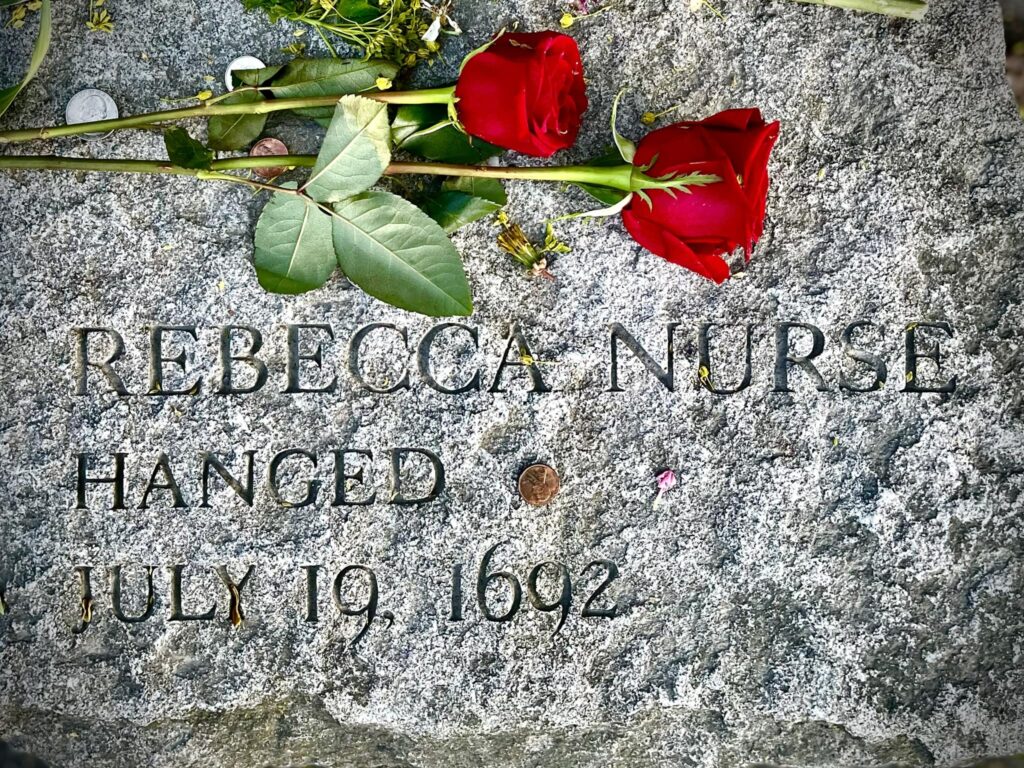
Today you can pay your respects at the Salem Witch Trials Memorial on Liberty Street, where his name is carved in stone, and at a memorial near Crystal Lake in West Peabody, on land he once owned.
WALK IN HIS FOOTSTEPS
Hear Giles Corey's story where it happened
Our historian-led 1692 Salem Historical Tour visits the sites tied to Corey and the other victims, telling the true stories behind the trials. Two hours, all ages, $35 adults / $10 kids.
Frequently asked questions
Giles Corey was pressed to death on September 19, 1692, after refusing to enter a plea to the charge of witchcraft. Because he would neither plead guilty nor not guilty, the court subjected him to an old English punishment known as peine forte et dure, in which increasingly heavy stones were placed upon the prisoner’s body until he entered a plea or died.
For years, many accounts claimed that Corey’s ordeal lasted two days. This interpretation came in part from Judge Samuel Sewall’s diary, which was believed to read, “Much pains was used with him two days.” However, spelling in the seventeenth century was far from standardized, and words were often written phonetically or abbreviated. A closer reading of Sewall’s original entry indicates that the phrase traditionally interpreted as “two days” was actually “today.” In other words, Sewall was recording that Corey was subjected to the pressing that day, not that the punishment continued for two days.
According to the accounts handed down, Giles Corey’s final words were “More weight.” Rather than beg for mercy or enter a plea, he reportedly asked for more stones to be added, making his death an act of defiance against the court.
By standing mute and refusing to plead guilty or not guilty, Corey denied the court the trial it needed to convict him. He knew a conviction would likely mean his estate would be seized by the colony, so his silence helped protect his property for his heirs, and refused to legitimize the trials.
Yes. Giles Corey is the only person in American history known to have been executed by pressing (peine forte et dure). The method was part of English common law but was virtually never used in the colonies.
Giles Corey is honored at the Salem Witch Trials Memorial on Liberty Street in Salem, where each victim has an inscribed stone bench. There is also a memorial near Crystal Lake in West Peabody, Massachusetts, on land he once owned.
Sources & further reading
This article draws on the original 1692 court records and firsthand accounts. To read the primary sources yourself:
- Giles Corey’s court records — Salem Witch Trials Documentary Archive, University of Virginia.
- The Diary of Samuel Sewall — including his September 19, 1692 entry on Corey’s death.