Salem Witch Trials
Rebecca Nurse: A Tale of Resilience in Salem
By Lori, History writer & tour co-founder • Updated September 2026 • 7 min read
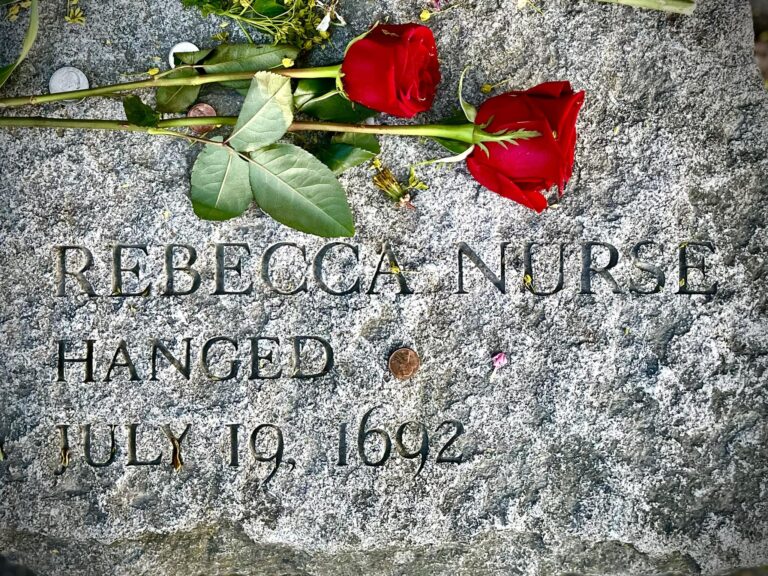
If any case proved the Salem Witch Trials had lost all reason, it was Rebecca Nurse’s. She was a frail, devout grandmother in her seventies, beloved by her neighbors. A jury first declared her innocent, and then, under pressure, took it back. Her hanging is one of the moments that began to turn the town against the trials themselves.
Hers is a story we tell with particular care on our Salem Witch Trials walking tour, because it strips away every excuse. There was no reason to believe Rebecca Nurse was a witch. People knew it at the time. And it happened anyway.
GILES COREY AT A GLANCE
WHO – A respected 71-year-old grandmother and devout church member of Salem Village
ACCUSED – March 1692, on spectral evidence from Ann Putnam Jr.
REMARKABLE – 39 neighbors signed a petition defending her, and the jury first found her not guilty.
EXECUTED – Hanged at Proctor’s Ledge, July 19, 1692
VISIT – The Rebecca Nurse Homestead in Danvers, MA
From England to Salem Village
Rebecca was born in 1621 in Great Yarmouth, England, the eldest of six children of William and Joanna Towne. Her parents were free-thinkers, so much so that their absence from communion drew legal scrutiny, and the community labeled them separatists. That pressure pushed the Townes to emigrate to New England in 1635, settling on a farm in the northern part of Salem Town.
Around 1644, Rebecca married Francis Nurse, a skilled tray maker. The couple moved to Salem Village and entered a lease-to-own agreement for a 300-acre farm, modest annual payments over 21 years, after which the land would be theirs. There they raised eight children and built the kind of respectable, hard-working life that should have placed Rebecca beyond suspicion.
A family already touched by rumor
Suspicion, though, had shadowed the Towne women before. Rebecca’s mother, Joanna, had moved to Topsfield and become an outspoken supporter of a controversial minister, Reverend Thomas Gilbert. In a small town, that was enough. Whispers of witchcraft began to swirl around Joanna, never formal charges, but rumors that clung to her until her death in 1682.
In the logic of the time, witchcraft was thought to pass from mother to daughter. So when the hysteria erupted a decade later, those old whispers resurfaced, and they landed on Joanna’s daughters.
The dispute that came back to haunt her
In 1689, Rebecca quarreled with a neighbor, Benjamin Holten, after his pigs broke into her garden and destroyed her crops. The argument was heated. Then Holten fell ill and died. At the time, it was simply a sad coincidence, but three years later, in the fevered climate of 1692, it would be twisted into “evidence” that Rebecca had bewitched him to death.
The accusation
On March 13, 1692, young Ann Putnam Jr. described a terrifying vision: a pale woman sitting in her grandmother’s chair. She couldn’t name the apparition at first. It was the adults around her, including the servant Mercy Lewis, who supplied a name: Rebecca Nurse. Ann agreed. With that, one of the most respected women in Salem Village was marked as a witch.
About a week later, four friends, Israel and Elizabeth Porter, Daniel Andrew, and Peter Cloyce, came to warn Rebecca that she’d been named. They found her sick in bed, where she’d been for a week. She spoke of her illness with quiet faith, and grieved for the afflicted children, promising to pray for them though she’d never gone near them. When they told her she had been accused, her response was heartbreakingly calm:
“Well, if it is so, the will of the Lord be done.”
— Rebecca Nurse, on learning she had been accused
“God will clear my innocence”
On March 23, Edward and Jonathan Putnam filed formal charges with Magistrates John Hathorne and Jonathan Corwin. The next day, Rebecca stood before them. Hathorne pressed her: “Goody Nurse, here are two girls that complain of you hurting them. What do you say to it?” Her answer never wavered:
“I can say before my eternal Father I am innocent, and God will clear my innocence.”
— Rebecca Nurse at her examination, March 24, 1692
The verdict that was overturned twice
What happened at Rebecca’s trial is the part most people don’t know, and it’s the most damning. So many in the community believed in her innocence that 39 of her neighbors signed a petition attesting to her good character, a genuinely dangerous thing to do in that climate.
On June 3, she was formally indicted for afflicting Ann Putnam Jr., Mary Walcott, Elizabeth Hubbard, and Abigail Williams. At trial, the jury did something extraordinary: they returned a verdict of not guilty. The accusers in the courtroom erupted into screaming fits. Rattled, the judges asked the jury to reconsider a single ambiguous remark Rebecca had made, and the jury reversed itself to guilty. An old, nearly deaf woman had lost her life to a sentence she likely never fully heard.
A FINAL INJUSTICE
Condemned, then quietly restored
Rebecca was excommunicated from her church and, on July 19, 1692, hanged at Proctor’s Ledge alongside four other women. Her family is believed to have recovered her body under cover of night and buried her on the homestead, where she rests today.
Years later, as Salem reckoned with what it had done, her excommunication was reversed and her family was granted restitution. It was far too late for Rebecca, but it was an admission the town had been catastrophically wrong.
Why Rebecca Nurse still matters
Rebecca Nurse is remembered not as a frightened victim but as a symbol of integrity under impossible pressure, a woman who met false accusation with faith and never once confessed to a lie that might have saved her. Her case, more than almost any other, showed the people of Salem that the trials had become a machine that could devour anyone, however blameless.
Today you can walk the grounds of the Rebecca Nurse Homestead in Danvers (once Salem Village), see her home and the family cemetery, and stand where her story truly ends.
WALK HER STORY
Hear Rebecca Nurse's story where it happened
Our historian-led 1692 Salem Historical Tour tells the true stories of Rebecca Nurse and the other victims, on the very streets where the trials unfolded. Two hours, all ages, $35 adults / $10 kids.
Frequently asked questions
Rebecca Nurse was first named through spectral evidence, when Ann Putnam Jr. claimed to see her apparition in March 1692. Old grievances fed the accusation too, a long-running land and boundary tension with the Putnam family, a neighbor’s death after a dispute with her, and decades-old rumors about her mother. Despite her spotless reputation, these combined to mark her as a target.
At first, yes. The jury initially returned a verdict of not guilty. But the afflicted accusers erupted in the courtroom, and the judges asked the jury to reconsider an ambiguous remark Rebecca had made. The jury then reversed its decision to guilty, and she was sentenced to death.
Rebecca Nurse was hanged on July 19, 1692, at Proctor’s Ledge in Salem, alongside four other women convicted of witchcraft. She was about 71 years old.
Rebecca Nurse was around 71 years old. Born in 1621 in England, she was an elderly, frail, and nearly deaf grandmother at the time of the 1692 trials, which made her conviction especially shocking to the community.
Yes. The Rebecca Nurse Homestead in Danvers, Massachusetts (formerly Salem Village) preserves her original home, a reproduction meeting house, and the family cemetery where she is believed to be buried. It is open seasonally, typically May through early November.
Sources & further reading
This article draws on the original 1692 court records and firsthand accounts. To explore the primary sources yourself:
- The Salem Witch Trials Documentary Archive and Transcription Project — University of Virginia, including Rebecca Nurse’s examination and the petition signed on her behalf.
- The Rebecca Nurse Homestead, Danvers, MA — her preserved home and family cemetery.