Salem Witch Trials
Sarah Good: The Beggar Whose Curse Haunted Salem
By Lori, History writer & tour co-founder • Updated September 2026 • 7 min read
She had nothing left to lose. Homeless, widowed into debt, begging door to door with a baby on her hip, Sarah Good was exactly the kind of person a frightened town looks to blame. She was among the very first accused in 1692, and on the gallows, she answered the minister demanding her confession with a curse that Salem never forgot.
Sarah Good’s story is one of the most heartbreaking we tell on our Salem Witch Trials walking tour, because it lays the whole tragedy bare: the trials didn’t go after the powerful. They went after the poor, the odd, and the defenseless first.
SARAH GOOD AT A GLANCE
WHO – A destitute, homeless beggar in Salem Village
ACCUSED – One of the first three accused — and the first person examined
TRAGEDY – Her infant died in jail; her 4-year-old daughter was also imprisoned
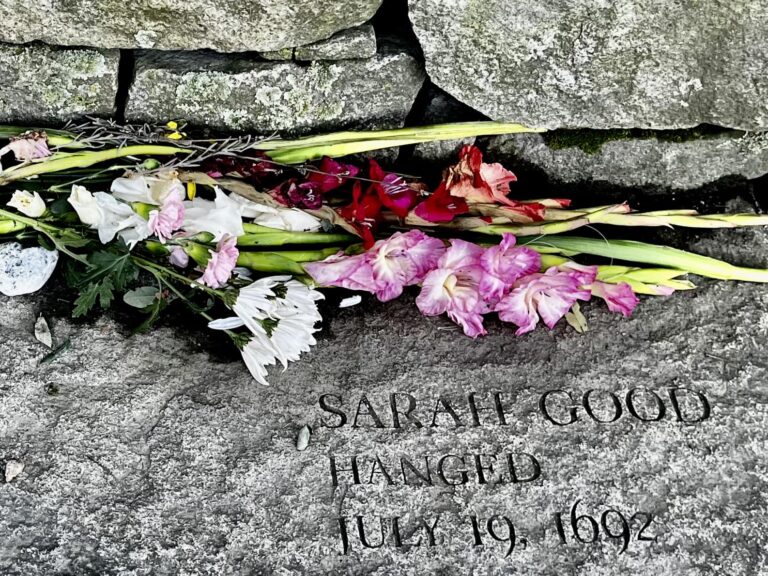
EXECUTED – Hanged at Proctor’s Ledge, July 19, 1692, with a defiant curse
A life of loss
Sarah was born in July 1653 in Wenham, Massachusetts, to John and Elizabeth Solart. Her father, a successful tavern innkeeper, built the family a home in 1670, but two years later, when Sarah was just 18, he died by suicide. He left no formal will, and his estate went to his widow. What should have been Sarah’s inheritance slipped away through the years that followed.
Her mother remarried a man named Ezekiel Woodward, who took control of the estate, and when Elizabeth died in 1678, the children were left fighting their stepfather for what was theirs. By 1682 Sarah received a token share, just three acres of meadowland. That same year she married Daniel Poole, who promptly died, leaving her his debts. To pay them, she had to sell even that small parcel of land. At not yet thirty, Sarah Good had already lost nearly everything.
Married to poverty
In 1683, Sarah married William Good, a laborer who struggled to find steady work. They had two children, Dorothy in 1688 and Mercy in late 1691. By the time Mercy was born, the family had lost their home entirely. Sarah was reduced to begging door to door, muttering as she left the homes that turned her away. In a superstitious village, a poor, resentful woman mumbling on your doorstep was all it took to plant a dangerous idea.
The perfect target
When the hysteria ignited in early 1692, Sarah Good never stood a chance. On January 16, Reverend Parris’s niece Abigail and daughter Betty fell into fits, crouching under chairs, contorting, babbling. Pressed to name who was tormenting them, the girls named Sarah Good, Sarah Osborn, and Tituba. Warrants went out on February 29, and examinations began March 1, starting with Sarah.
Sent to Ipswich jail with her infant Mercy, she tried to escape the very first night, leaving her shoes and stockings behind in her desperation. With nowhere safe to run, she was forced back, then moved to the Boston jail.
A four-year-old in chains
Because witchcraft was believed to pass from mother to child, the accusers soon turned on Sarah’s little daughter. Dorothy Good was four years old. The afflicted girls claimed she bit and pinched them. When interrogated, the terrified child said that she and her mother were witches, and that her mother had given her a snake, a familiar, that suckled on her finger. On that “confession,” a four-year-old was chained in a Boston jail for months. By some accounts, she never fully recovered.
Death in the cells
The cruelty wasn’t finished. Before Sarah’s trial even began, her infant daughter Mercy died in jail, the hysteria’s second fatality, after Sarah Osborn, who also died behind bars awaiting trial. Sarah went to court having already lost a child to the very process that was about to kill her.
“God will give you blood to drink”
On June 28, 1692, Sarah Good was tried and convicted. On July 19, she was led to Proctor’s Ledge. There, Reverend Nicholas Noyes urged her one last time to confess and save her soul. Sarah’s answer was pure, furious defiance, and it became one of the most famous lines of the entire trials:
“I am no more a witch than you are a wizard, and if you take away my life, God will give you blood to drink.”
— Sarah Good to Rev. Nicholas Noyes, on the gallows, July 19, 1692
THE CURSE OF SARAH GOOD
Blood to drink
Sarah’s words were remembered as a curse, and Salem lore insists it came true. Years later, in 1717, Reverend Nicholas Noyes is said to have died of an internal hemorrhage, choking on his own blood. Whether coincidence or something stranger, the town never forgot that a destitute beggar had promised it, and that it seemed to come to pass.
Remembering Sarah Good
Several places still carry Sarah Good’s story. A few are private homes — please view them only from the street:
Salem Witch Trials Memorial
charter street, salem
Beside the Old Burying Point, a stone bench is dedicated to Sarah Good among the twenty victims.
Proctor's Ledge Memorial
33 POPE STREET, SALEM
The confirmed execution site where Sarah and 18 others were hanged, with each victim’s name and date inscribed.
Witchcraft Victims Memorial
172 HOBART STREET, DANVERS
Standing on what was once Salem Village, where the accusations first began.
WALK HER STORY
Hear Sarah Good's story where it happened
Our historian-led 1692 Salem Historical Tour tells the true stories of Sarah Good and the other victims, on the very streets where the trials unfolded. Two hours, all ages, $35 adults / $10 kids.
Frequently asked questions
Sarah Good was a destitute, homeless beggar in Salem Village and one of the first three people accused of witchcraft in 1692, along with Sarah Osborn and Tituba. She was the first person examined in the trials and was hanged on July 19, 1692.
Sarah Good was an easy target. She was poor, homeless, and often seen begging and muttering at people’s doors, which made her an outcast in a fearful, superstitious community. When the first afflicted girls were pressed to name their tormentors, a marginalized woman like Sarah was an obvious choice.
When Reverend Nicholas Noyes urged her to confess at her execution, Sarah Good replied, “I am no more a witch than you are a wizard, and if you take away my life, God will give you blood to drink.” It was remembered as a curse — and according to legend, Noyes later died of a hemorrhage, choking on his own blood.
Dorothy Good, Sarah’s daughter, was only four years old when she was accused and imprisoned. Under interrogation she said that she and her mother were witches, and she was held in chains in a Boston jail for months. She survived but is said to have been deeply and permanently affected by the ordeal.
Sarah Good was convicted of witchcraft on June 28, 1692, and hanged on July 19, 1692, at Proctor’s Ledge in Salem, Massachusetts, alongside Rebecca Nurse, Susannah Martin, and two other women.
Sources & further reading
This article draws on the original 1692 court records and firsthand accounts. To read the primary sources yourself:
- Sarah Good’s court records — Salem Witch Trials Documentary Archive, University of Virginia.
- The Salem Witch Trials Documentary Archive and Transcription Project — the full collection of original court records and transcriptions from 1692.