Salem Witch Trials
The Salem Witch House: The Last Building Tied to the 1692 Trials
By Lori, History writer & tour co-founder • Updated September 2026 • 6 min read
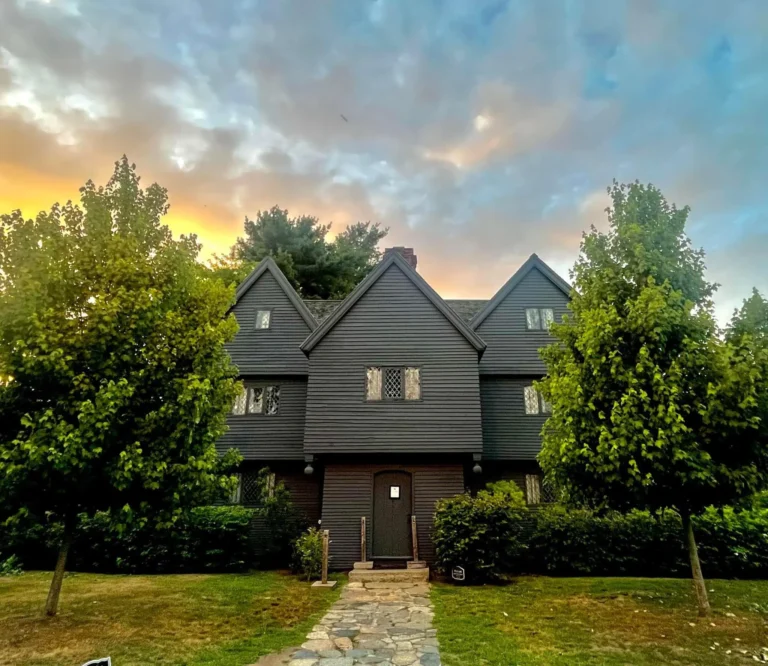
Of all the sites in Salem, only one can claim a direct, documented link to the witch trials of 1692. The dark, steep-gabled Witch House was the home of one of the judges who sent the accused to the gallows. It’s the closest you can get to actually standing inside the story.
It’s one of the first stops people picture when they plan a trip to Salem, and a landmark we pass on our Salem Witch Trials walking tour. Here’s what it really is and what to know before you visit.
THE WITCH HOUSE AT A GLANCE
WHAT – The Jonathan Corwin House — home of a 1692 trial magistrate
CLAIM TO FAME – The only structure in Salem with direct ties to the witch trials
STYLE – First Period colonial — steep gables, dark clapboard, diamond-paned windows
WHERE – 310 Essex Street, Salem, MA (corner of Essex & North)
NOTE – It’s a museum with its own tours; our walking tour passes it but does not go inside
Who was Jonathan Corwin?
The house takes its everyday name, the “Witch House”, from its most infamous resident. Jonathan Corwin was a wealthy Salem merchant and magistrate who became one of the judges who examined the people accused of witchcraft in 1692. He bought the house in 1675 and lived here throughout the trials. Because of his central role, his home became permanently linked to that terrible year, the last physical place you can stand and know, for certain, that one of the trials’ decision-makers walked these same floors.
A Common Misconception
Despite the name, no trials or hangings took place inside the Witch House. The examinations were held in meetinghouses and taverns, and executions at Proctor’s Ledge. The house is called the “Witch House” because of Corwin’s role as a witch-trial judge, not because witchcraft was practiced or judged within its walls.
The architecture: a window into 1692
Part of the Witch House’s power is simply how old it looks — because it genuinely is. It’s a rare surviving example of First Period architecture, the style English settlers brought to New England in the 1600s. Look for the hallmarks:
- A steeply pitched, multi-gabled roof
- Dark clapboard siding and heavy exposed timber framing
- A projecting second-story overhang, or “jetty”
- Diamond-paned leaded casement windows that glint like something out of a storybook
Walking past it at dusk, it’s easy to feel you’ve stepped back three centuries, which is exactly the point.
Saved from the wrecking ball
The Witch House nearly didn’t survive the twentieth century. In the 1940s, a street-widening project on Essex Street threatened to demolish it. Instead, preservationists moved the entire house back from the road and carefully restored it to its 17th-century appearance. It opened to the public as a museum, furnished to reflect the era, and has welcomed visitors ever since. Had that effort failed, Salem would have lost its only tangible tie to 1692.
Visiting the Witch House today
The Witch House operates as a historic house museum with its own guided and self-guided tours, period furnishings, and exhibits on Corwin, Puritan life, and the trials. It’s open year-round, and gets very busy during Salem’s packed October season, so plan ahead if you’re visiting in the fall.
One important note: our 1692 Salem Historical Tour passes the Witch House and tells its story from the street, but does not go inside. Touring the interior is a separate, worthwhile stop you can add to your day.
SEE IT WITH A HISTORIAN
The Witch House is just the beginning
Our 1692 Salem Historical Tour connects the Witch House to the full story — the accused, the accusers, the memorials, and the streets where it all unfolded. Two hours, all ages, $35 adults / $10 kids.
Frequently asked questions
The Salem Witch House is the former home of Jonathan Corwin, one of the magistrates who judged the accused during the 1692 Salem Witch Trials. It is the only building still standing in Salem with a direct, documented connection to the trials, and today it operates as a historic house museum on Essex Street.
No. No trials or executions took place inside the house. The examinations were held in meetinghouses and taverns, and the executions at Proctor’s Ledge. The house is called the “Witch House” because Judge Jonathan Corwin, who lived there, was one of the witch-trial magistrates.
It is a 17th-century First Period home. Judge Jonathan Corwin acquired the house in 1675 and lived there during the 1692 trials, which is the source of its direct historical connection.
Yes. The Witch House is a museum with guided and self-guided tours, period furnishings, and exhibits, open seasonally (and very busy in October). Note that our 1692 Salem Historical Tour passes the house and tells its story from the street but does not enter — the interior tour is a separate visit.
The Witch House is at 310 Essex Street, Salem, Massachusetts, on the corner of Essex and North Street, in the historic downtown.
Sources & further reading
- The Witch House / Jonathan Corwin House — the official museum site, for hours, tickets, and visiting details.
- The Salem Witch Trials Documentary Archive — University of Virginia, for the original court records of the trials Corwin judged.