Salem Witch Trials
Bridget Bishop: The First to Hang in Salem
By Lori, History writer & tour co-founder • Updated September 2026 • 7 min read
On June 10, 1692, a Salem woman named Bridget Bishop became the first person put to death in the witch trials. She was not the first accused, far from it. The court chose to try her first for a colder reason: she had a reputation, and they were confident a jury would convict her. They were right. Her hanging opened the floodgates.
Bridget Bishop is one of the most misremembered figures of 1692, and one we’re always glad to set straight on our Salem Witch Trials walking tour. Much of what people think they know about her isn’t true at all, it’s a case of mistaken identity that’s lasted more than a century.
BRIDGET BISHOP AT A GLANCE
WHO – A twice-widowed Salem woman with an apple orchard and a quarrelsome reputation
DISTINCTION – The first person executed in the Salem Witch Trials
CHOSEN FIRST – Because officials believed her past made conviction a sure thing
EXECUTED – Hanged at Proctor’s Ledge, June 10, 1692
A hard life before the trials
Born in England around the early 1630s under the name Playfer, Bridget crossed to the Massachusetts Bay Colony as a young woman. By the time of the trials, she had outlived two husbands. Her second marriage, to a man named Thomas Oliver, was openly turbulent, the couple was hauled before the court for fighting, and a neighbor testified to seeing Bridget bruised and bloodied more than once. On another occasion, Bridget was sentenced to stand in the public market, gagged, for the offense of cursing her husband. In a rigid Puritan town, a woman who fought back and spoke her mind was already a marked person.
When Oliver died in 1679, Bridget inherited most of his modest estate, and almost immediately his children from an earlier marriage accused her of having bewitched him to death. The charge went nowhere for lack of evidence, and many suspected it was really about the property. It would not be the last time an old grudge resurfaced as an accusation of witchcraft. She later married Edward Bishop, a sawyer, and kept an orchard and chickens in what is now downtown Salem.
setting the record straight
No, she wasn't a flashy tavern keeper
You’ll often hear Bridget Bishop described as a scandalous tavern owner in a bright red bodice, flouting Puritan decorum. It’s a vivid image, and it’s wrong. That portrait comes from a 19th-century historian who confused Bridget with a different accused woman, Sarah Bishop, who happened to be married to a man with the same name. Careful research later untangled the two, but the myth stuck. The real Bridget was an ordinary, if contentious, Salem townswoman, which makes what happened to her all the more sobering.
Arrest and examination
Bridget was arrested on April 18, 1692, named by the same circle of afflicted accusers who drove so many of the cases, among them Mercy Lewis, Abigail Williams, Elizabeth Hubbard, and Ann Putnam Jr. The next day she was examined by Judges John Hathorne and Jonathan Corwin, and Hathorne went straight for her past, pressing her about the old claim that she had killed her first husband by witchcraft. Each time she denied it, the afflicted in the room reportedly writhed in fresh torment. Her answers never changed:
“I am no witch. I know not what a witch is.”
— Bridget Bishop at her examination, from the court record, April 1692
It made no difference. She was sent to jail to await her trial.
The evidence against her
Over the following weeks, more than ten witnesses came forward with lurid stories, most of them drawn from years-old grievances suddenly recast as proof of the devil’s work. The testimony gives a chilling tour of what passed for evidence in 1692:
- A man claimed her spectral shape pressed on him at night, then sent a black pig and a grotesque talking creature to torment him after a quarrel over her wandering chickens.
- Another swore that years earlier her apparition had appeared in his home the night his infant fell fatally ill.
- Workers hired to tear down a cellar wall of her former house testified they’d found poppets – cloth dolls stuck with headless pins- hidden in the masonry.
- A court-ordered physical examination claimed to find a “witch’s mark” on her body, though a second inspection hours later found nothing of the kind.
None of it was evidence in any sense we’d recognize today. But in a courtroom primed to believe, it was more than enough.
A one-day trial
On June 2, 1692, Bridget Bishop went before the newly convened court, led by Deputy Governor William Stoughton. She had no lawyer; no one dared defend her. Her trial began and ended in a single day. The court’s own chronicler, the minister Cotton Mather, summed up the mood of the proceedings with a line that reveals just how little her guilt was ever in question:
“There was little occasion to prove the witchcraft, it being evident and notorious to all beholders.”
— Cotton Mather, on Bridget Bishop’s trial
The jury found her guilty. Her death warrant was signed on June 8, and on the morning of Friday, June 10, 1692, Bridget Bishop was taken to Proctor’s Ledge and hanged, the first of the twenty who would die before the hysteria burned out. Denied burial in consecrated ground, she was, in the sheriff’s own blunt words, “buried on the spot.”
Cleared at last — three centuries later
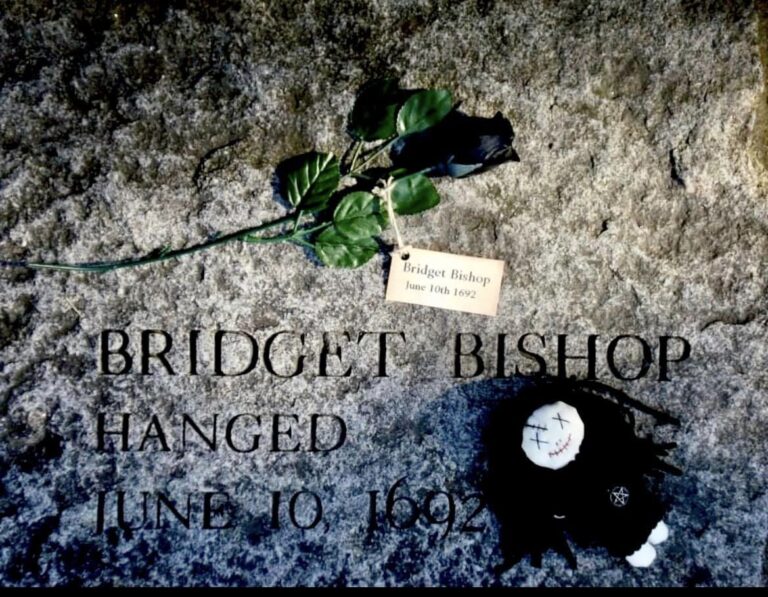
Justice came for Bridget Bishop almost unimaginably late. When Massachusetts began clearing the names of the accused and offering restitution in 1711, her family never came forward, and her name was left off the list. A partial apology in 1957 missed her too. It was not until 2001, more than 300 years after her death, that the Massachusetts legislature finally, formally cleared Bridget Bishop’s name, along with a handful of other victims who had been overlooked. Today she is remembered with a stone marker at the Salem Witch Trials Memorial and at Proctor’s Ledge.
There’s a quiet irony in her story’s geography, too: the site of her old orchard on Church Street is now home to a Salem restaurant, a stop with its own eerie reputation that we visit on our Bloodbath Adult Ghost Tour.
WALK HER STORY
Hear Bridget Bishop's story where it happened
Our historian-led 1692 Salem Historical Tour tells the true stories of Bridget Bishop and the other victims on the very streets where the trials unfolded. Two hours, all ages, $35 adults / $10 kids.
Frequently asked questions
Bridget Bishop was a twice-widowed Salem townswoman who became the first person executed in the 1692 Salem Witch Trials. Born in England around the early 1630s, she had a long-standing reputation for quarrelling and had faced a witchcraft accusation years before 1692.
Bridget Bishop was not the first person accused, but officials are believed to have chosen to try her first because her troubled reputation and earlier witchcraft accusation made a guilty verdict almost certain. Her conviction set the precedent for the executions that followed.
No. That popular image comes from a 19th-century mix-up that confused Bridget Bishop with another accused woman, Sarah Bishop, who was married to a man with the same name. The real Bridget Bishop was an ordinary Salem townswoman who kept an orchard, not a colorful tavern owner.
The case rested on spectral evidence and old grudges: neighbors described her apparition tormenting them, poppets stuck with pins were said to have been found in a wall of her former house, and a court-ordered search claimed to find a “witch’s mark” (which a later examination did not confirm). None of it was credible evidence by modern standards.
After a one-day trial on June 2, 1692, Bridget Bishop was found guilty and hanged on June 10, 1692, at Proctor’s Ledge in Salem — the first of the twenty people executed during the trials. Her name was not formally cleared until 2001.
Sources & further reading
This article is based on the original 1692 court records and established historical research. To explore the sources yourself:
- Bridget Bishop’s court records (SWP No. 013) — Salem Witch Trials Documentary Archive, University of Virginia.
- The Salem Witch Trials Documentary Archive and Transcription Project — the full collection of original court records and transcriptions from 1692.