Salem Witch Trials
Mary Parker: The Andover Widow They May Have Hanged by Mistake
By Lori, History writer & tour co-founder • October 2026 • 10 min read
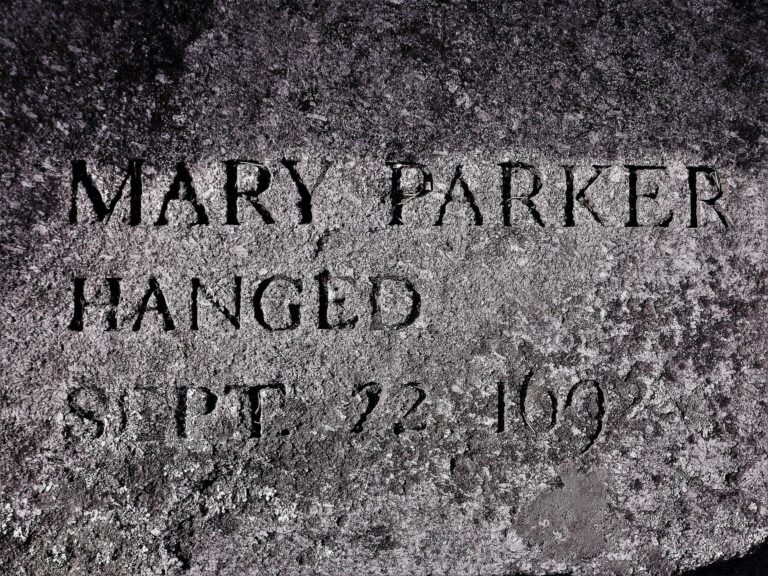
She stood before the court and said the one thing no one wanted to hear: there was another woman by her name in Andover. She may well have been right. Mary Parker was a respectable widow with no enemies and no record of trouble, and to this day, historians suspect that Salem, in its blind panic, may have hanged the wrong woman.
Hers is one of the most unsettling cases we discuss on our Salem Witch Trials walking tour, because it exposes the final, terrible truth about 1692: the court had become so careless with human life that it could no longer even be certain who it was killing.
MARY PARKER AT A GLANCE
WHO – A respectable, well-off widow from Andover, Massachusetts
ACCUSED – September 1, 1692, by a 15-year-old boy’s confession
HER DEFENSE – She told the court there was another Mary Parker in Andover
CONVICTED ON – The word of just two “confessing witches”
EXECUTED – Hanged September 22, 1692 — the final hangings
A respectable Andover widow
Mary Ayer was born around 1637 and came to Massachusetts as a girl, her family eventually settling in Haverhill. At about fifteen she married Nathan Parker, a widower and local scribe, and together they raised nine children in Andover. Theirs was a hard but respectable life, marked by the losses any colonial family knew, one son killed in King Philip’s War, another dead young. When Nathan died in 1685, he left Mary a comfortable estate of more than two hundred acres. By 1692 she was a settled, well-off widow with no previous brushes with the law and no recorded quarrels with her neighbors. Why the trials came for her at all remains, genuinely, a mystery.
When the panic reached Andover
In July of 1692, the hysteria that began in Salem Village spread north to Andover, and there it exploded. Townspeople accused one another by the dozen, and confessions, often coerced, fed an ever-growing list of names. Mary Parker’s own family was already caught in it: nearly all the women of her daughter Hannah’s in-laws, the Tyler family, had been accused. In that climate, a name could be spoken almost at random and become a death sentence.
Named by a boy
On September 1, 1692, a fifteen-year-old named William Barker Jr. named Mary Parker in his own confession, claiming she had flown with him to afflict a girl and had been baptized by the devil at a local pond. On the strength of a teenager’s fantastical story, Mary Parker was arrested the next day and brought before Judges Bartholomew Gedney, John Hathorne, and John Higginson.
“There is another woman of the same name”
The moment her name was read aloud, the afflicted girls collapsed into fits. Mary Parker denied everything and offered the court a simple, rational explanation:
“I know nothing of it. There is another woman of the same name in Andover.”
— Mary Parker at her examination, from the court record, September 1692
It should have given any careful court pause. Andover did have more than one Mary Parker. But this court was long past caution. The accusers simply insisted she was the one, and the usual theater followed: the girls fell, Mary “cured” them with a touch, and that touch was taken as proof of her guilt rather than her innocence.
Condemned on the word of two confessors
Mary Parker was indicted on three charges of afflicting local girls, and her trial opened on September 16. The case against her was astonishingly thin. According to the surviving records, only two people testified against her: William Barker Jr., the boy who had named her, and Mercy Wardwell. Both were themselves confessed “witches,” naming others in the desperate hope of saving their own lives. On that foundation, a boy’s confession and an accusation from a fellow accused, Mary Parker, was found guilty on September 17 and sentenced to hang.
A CASE OF MISTAKEN IDENTITY?
Which Mary Parker did they hang?
Mary Parker’s protest was not a desperate dodge, it may have been the truth. There really were multiple women named Mary Parker in Andover, and historians who have studied her case closely suspect that confusion and gossip, not evidence, sent her to the gallows. Her own record was spotless; she had no quarrels, no enemies, no reason to be named. It is entirely possible that the court conflated her with another woman of the same name, and that the real “Goody Parker” they were after, whoever she was, was never the respectable widow they killed.
September 22, 1692
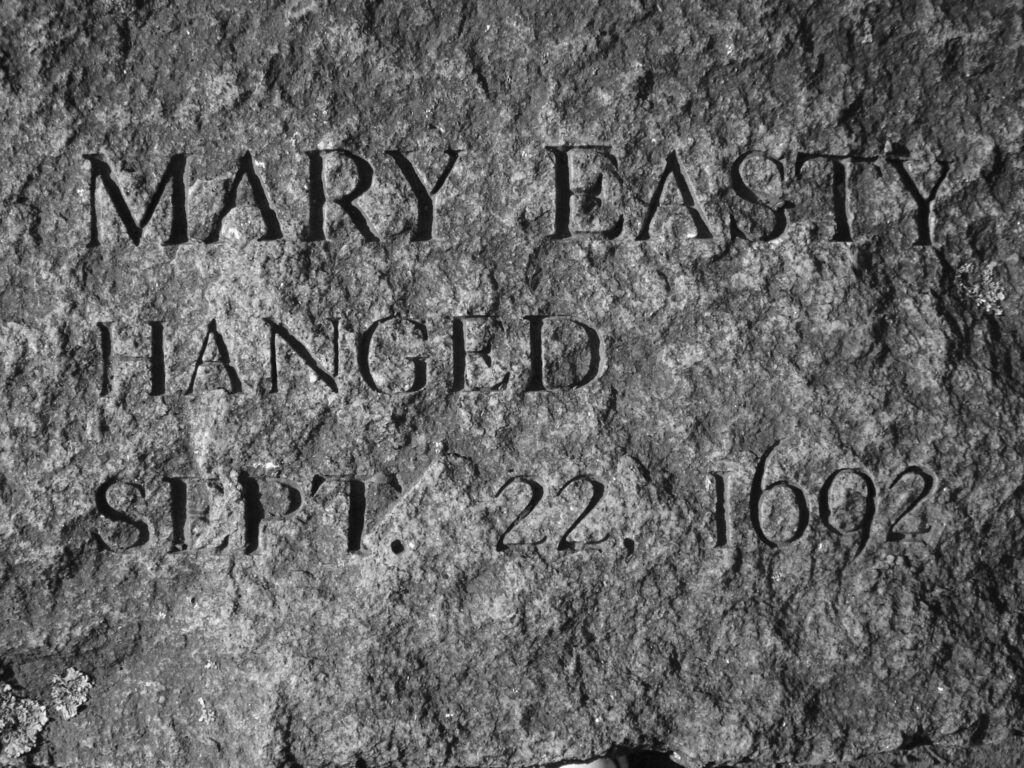
On September 22, 1692, Mary Parker was carried by cart to Proctor’s Ledge with seven others, among them Mary Esty, Martha Corey, Alice Parker, Ann Pudeator, Wilmot Redd, Margaret Scott, and Samuel Wardwell- in what proved to be the last hangings of the Salem Witch Trials. As the cart struggled up the steep hill and stuck fast, the accusers cried that the devil was holding it back. Every one of the eight prisoners declared their innocence to the end. As their bodies hung, Reverend Nicholas Noyes looked up and sneered, “What a sad thing it is to see eight firebrands of hell hanging there.”
Robbed in death
Even after the hanging, the cruelty continued, this time as naked greed. Sheriff George Corwin sent an officer to seize Mary Parker’s estate, but she had none; her property had passed to her children years before. So the officer seized the property of her sons instead, carrying off their cattle, corn, and hay. When John and Joseph Parker went to get it back, the sheriff demanded a bribe:
“He at first demanded ten pounds of us, but at length was willing to take six… if our mother had left any estate, we know not of any law… by which it should be forfeited.”
— Petition of John and Joseph Parker, 1692
A daughter of Mary’s had also been imprisoned during the panic. Years later, in 1710, the surviving family petitioned for justice, and in 1711 Mary Parker’s name was finally cleared and a small restitution paid. But her grave was never found, and the question at the heart of her case, whether Salem even killed the right woman, can never now be answered.
WALK HER STORY
Hear Mary Parker's story where it happened
Our historian-led 1692 Salem Historical Tour tells the true stories of Mary Parker and the other victims on the very streets where the trials unfolded. Two hours, all ages, $35 adults / $10 kids.
Frequently asked questions
Mary Ayer Parker was a respectable, well-off widow from Andover, Massachusetts, and one of the twenty people executed during the 1692 Salem Witch Trials. She was hanged on September 22, 1692, in the final group of executions.
Possibly. At her examination, Mary Parker told the court there was another woman of the same name in Andover, and there really were multiple Mary Parkers in the town. Because she had no quarrels, no enemies, and no clear reason to be accused, many historians suspect that confusion over her identity — not any evidence — led to her conviction.
There is no clear reason. Mary Parker was named during the 1692 Andover panic by a 15-year-old confessor, William Barker Jr. She had a spotless reputation, so her accusation remains one of the genuine mysteries of the trials, likely driven by the chaos of mass accusations and possible mistaken identity.
Because Mary had no estate of her own, Sheriff George Corwin seized her sons’ property instead — their cattle, corn, and hay — and demanded a bribe to return it. A daughter of hers was also imprisoned during the panic. The family petitioned for justice, and in 1711 Mary Parker’s name was cleared and a small restitution was paid.
Mary Parker was hanged on September 22, 1692, at Proctor’s Ledge in Salem, alongside Mary Esty, Martha Corey, Alice Parker, and four others — the last group executed during the Salem Witch Trials. Her grave has never been found.
Sources & further reading
This article draws on the original 1692 court records and firsthand accounts. To read the primary sources yourself:
- Mary Parker’s court records (SWP No. 98) — Salem Witch Trials Documentary Archive, University of Virginia.
- The Salem Witch Trials Documentary Archive and Transcription Project — the full collection of original court records and transcriptions from 1692.