Salem Witch Trials
Martha Corey: The “Gospel Woman” They Called a Witch
By Lori, History writer & tour co-founder • October 2026 • 10 min read
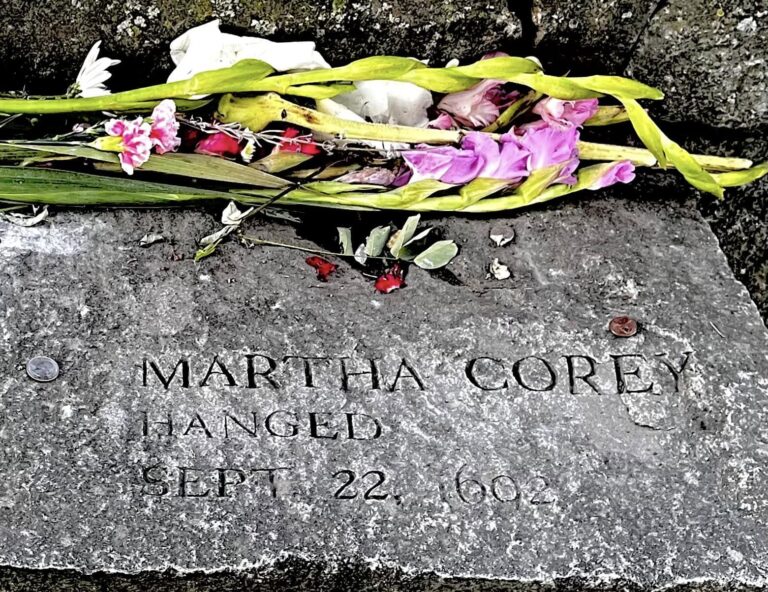
Martha Corey was a devout, church-covenanted woman who thought the whole witch hunt was nonsense, and wasn’t shy about saying so. When Salem accused her, it shattered the last comforting illusion the town had been clinging to: that only the poor, the odd, and the outcast had anything to fear. If a gospel woman could hang, no one was safe.
She was also the wife of Giles Corey, and her story and his are bound together to the bitter end — one of the most haunting pairings we tell on our Salem Witch Trials walking tour.
MARTH COREY AT A GLANCE
WHO – A devout church member and the third wife of Giles Corey
WHY SHE MATTERED – The first fully respectable, covenanted church member accused — proof no one was safe
HER NATURE – Sharp, skeptical, and openly scornful of the afflicted girls
EXECUTED – Hanged September 22, 1692 — among the last to die
HER HUSBAND – Giles Corey was pressed to death just three days earlier
A complicated past
Martha’s life before Giles was not the tidy story a Puritan village liked to tell. In 1677 she had a son out of wedlock, a mixed-race child raised in another family’s home. In 1684 she married Henry Rich and had a son with him. After Henry died, she married the wealthy farmer Giles Corey on April 27, 1690, becoming his third wife. Giles carried his own tarnished reputation; years earlier, he had stood trial in the beating death of a farmhand and escaped with only a fine. Whatever her past, by 1692 Martha had made herself into something Salem respected: a full member of the church.
The skeptic who said too much
When the hysteria began, Martha and Giles were among the curious who went to watch the examinations. But Martha quickly soured on the whole spectacle, openly doubting that the afflicted girls were telling the truth. When Giles wanted to go back for more, she tried to talk him out of it, and, in a move that would haunt her, hid his saddle so he couldn’t ride to the meetinghouse. To a frightened town, that didn’t look like common sense. It looked like a woman trying to protect the witches.
The accusation that broke the rules
Then Ann Putnam Jr. cried out that Martha Corey’s spirit was tormenting her, and Salem reeled. Every earlier target had been easy to believe: a beggar, an outcast, a quarrelsome old woman. Martha Corey was a pious, respectable, covenanted church member, and no one of her standing had ever been named. If the devil could claim her, the panic suddenly had no limits.
“Does she tell you what clothes I have on?”
Two village men, Edward Putnam and Ezekiel Cheever, decided to investigate before any warrant was filed. First they asked Ann Putnam Jr. what Martha’s spectral shape had been wearing, but the girl claimed Martha’s spirit had blinded her so she couldn’t say. When the men arrived at the Corey home anyway, Martha met them with unsettling composure:
“I know what you are come for. You are come to talk with me about being a witch… but does she tell you what clothes I have on?”
— Martha Corey to Edward Putnam & Ezekiel Cheever, from the court record, March 12, 1692
To us, it reads like a sharp woman who’d been tipped off and was calling their bluff. To Putnam and Cheever, it was proof: how could she know the question about the clothes unless by witchcraft? That single, mocking line effectively sealed her fate before any trial began.
Defiance in the meetinghouse
A warrant was issued for Martha on Saturday, March 19, but too late in the day to serve, and the law forbade serving warrants on the Sabbath. So on Sunday, March 20, Martha Corey did the unthinkable: she walked into the meetinghouse and took her place in worship among the pious, a suspected witch sitting in her Sunday best, and no one could legally remove her. The visiting minister Deodat Lawson was preaching when the afflicted girls erupted, crying out that they saw a yellow bird suckling between her fingers. It was a spectacle Salem never forgot.
“I am a gospel woman”
At her examination the next day, Judge John Hathorne hammered her about the clothes question, about the yellow bird, about a man the girls claimed was whispering in her ear. Martha held firm, and at one point cut to the heart of it:
“We must not believe all that these distracted children say… I am an innocent person. I never had to do with witchcraft since I was born. I am a gospel woman.”
— Martha Corey at her examination, from the court record, March 1692
It was the truest thing anyone said that day, and it changed nothing. According to Lawson, when she called herself a gospel woman, the afflicted girls had an answer ready: she was a “gospel witch.” Every time she moved her head, they convulsed. She was indicted and sent to jail.
Betrayed by her own husband
Here the story takes its cruelest turn. Giles Corey testified against his own wife. Swept up in the fear like so many others, he told the court about small domestic strangenesses, a lame ox, a sick cat, a moment when he felt mysteriously “stopped” during prayer, as if they were evidence that she was a witch. But when Giles himself was arrested weeks later, something in him turned. At his own examination, he refused to repeat the damning testimony and brushed the court’s questions aside. The man who had helped condemn his wife would, in the end, die rather than cooperate with the court that was killing them both.
Condemned and cast out
The court delayed Martha’s trial for months; convicting a respected churchwoman was no easy thing, but in September it finally moved. On September 8, 1692, she was found guilty and sentenced to death. Three days later, Reverend Samuel Parris came to her cell to tell her the church had excommunicated her. By his own account, she was “obdurate,” defending herself to the last and declining even to pray with him. Salem had stripped her of her life and, now, of the faith she had claimed as her shield.
Three days apart
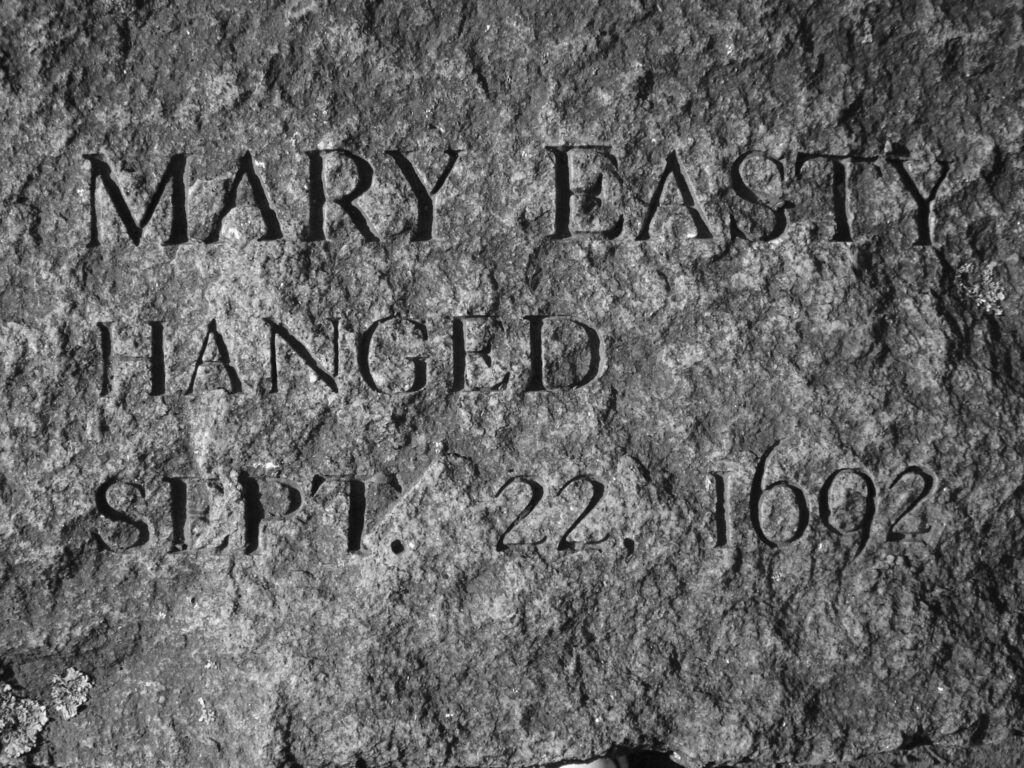
The end came for Martha and Giles within the same terrible week. On September 19, 1692, Giles Corey was pressed to death under stones for refusing to enter a plea. Three days later, on September 22, Martha Corey was carried by cart to Proctor’s Ledge with seven others, among them Mary Esty, Alice Parker, Mary Parker, Ann Pudeator, Wilmot Redd, Margaret Scott, and Samuel Wardwell in what would be the last hangings of the Salem Witch Trials. The eyewitness Robert Calef recorded that the cart stalled on the way, and the accusers claimed the devil was holding it back. Martha’s answer was the only one she had ever given:
“Martha Corey, protesting her innocence, concluded her life with an eminent prayer upon the ladder.”
— Robert Calef, eyewitness, on Martha Corey’s execution, September 22, 1692
THE TURNING POINT
A gospel woman, praying as she died
They had called her a “gospel witch.” She answered them from the gallows ladder the only way she could, with a prayer so earnest that even hostile witnesses remembered it. Martha Corey’s hanging was among the very last of the trials. Within weeks, the court finally barred the spectral evidence that had condemned her and everyone else, and the madness began to collapse.
WALK HER STORY
Hear Martha Corey's story where it happened
Our historian-led 1692 Salem Historical Tour tells the true stories of Martha Corey and the other victims on the very streets where the trials unfolded. Two hours, all ages, $35 adults / $10 kids.
Frequently asked questions
Martha Corey was a devout member of the Salem church and the third wife of farmer Giles Corey. One of the twenty people executed during the 1692 Salem Witch Trials, she was hanged on September 22, 1692 — among the last to die.
Martha Corey was the first fully respectable, covenanted church member to be accused. Earlier targets had been social outcasts, so her accusation shocked the community and signaled that no one, regardless of piety or standing, was safe from the hysteria.
Martha openly doubted and mocked the afflicted girls and tried to keep her husband from attending the examinations, even hiding his saddle. That skepticism made her look like she was shielding witches, and when she seemed to have “supernatural” knowledge during a visit from two investigators, it convinced them she was guilty.
Martha defended herself by insisting she was a “gospel woman” — a pious, faithful church member incapable of witchcraft. According to the minister Deodat Lawson, the afflicted girls mockingly replied that she was a “gospel witch,” claiming she used her faith as a disguise.
Martha Corey was hanged at Proctor’s Ledge on September 22, 1692, in the final group of executions, and witnesses said she died praying on the ladder. Her husband, Giles Corey, had been pressed to death with stones just three days earlier, on September 19, for refusing to enter a plea.
Sources & further reading
This article draws on the original 1692 court records and firsthand accounts. To read the primary sources yourself:
- Martha Corey’s court records (SWP No. 38) — Salem Witch Trials Documentary Archive, University of Virginia.
- More Wonders of the Invisible World — By Robert Calef
- The Salem Witch Trials Documentary Archive and Transcription Project — the full collection of original court records and transcriptions from 1692.