Salem Witch Trials
Mary Esty: The Woman Who Begged for Everyone but Herself
By Lori, History writer & tour co-founder • October 2026 • 10 min read
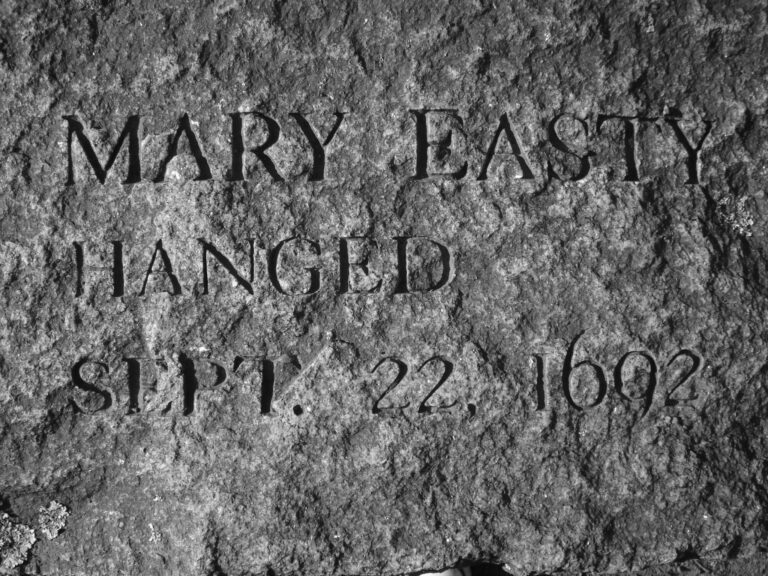
Condemned to hang, knowing nothing on earth could save her, Mary Esty picked up a pen and wrote to the judges who had sentenced her. She did not plead for her own life. She begged them, instead, to stop, so that no more innocent people would die after she was gone. It may be the most selfless act of the entire Salem Witch Trials, and it came from a woman the court was days from killing.
Hers is a story that moves people to this day, and one we always pause over on our Salem Witch Trials walking tour — because Mary Esty, facing the gallows, showed more wisdom and grace than the entire court that condemned her.
MARY ESTY AT A GLANCE
WHO – A devout Topsfield farm wife — and sister of Rebecca Nurse and Sarah Cloyce
ACCUSED – April 1692, weeks after both of her sisters
NEARLY FREED – Released, then re-arrested within 48 hours
HER LEGACY – A petition pleading that no more innocent blood be shed
EXECUTED – Hanged September 22, 1692 — the final hangings
One of three sisters
Mary Towne was baptized in Yarmouth, England, in 1634, one of the many children of William and Joanna Towne. The family crossed to Massachusetts and eventually settled in Topsfield. Around 1655, Mary married Isaac Esty, a farmer and barrel-maker, and the couple raised seven children on one of the area’s largest farms. By every account, the Townes were a respected, upstanding family. That would not save them. Mary’s sisters were Rebecca Nurse and Sarah Cloyce, and in 1692, all three sisters would be accused of witchcraft. Two of them, Rebecca and Mary, would hang.
A family marked for the hunt
Why would the trials devour one respectable family so completely? The answer lies in old grudges. Decades earlier, the sisters’ mother, Joanna Towne, had been whispered about as a witch after she stood up in a bitter Topsfield church dispute against the powerful Gould family. The Goulds, it happens, were close friends of the Putnams, the clan that would become the most relentless accusers of 1692. The bad blood deepened in 1686, when Mary’s husband Isaac and other Towne men testified against Captain John Putnam for cutting timber on Topsfield land, and the court ruled against Putnam. Add to all that the widespread belief that witchcraft passed from mother to daughter, and a reputable family suddenly looked, to its enemies, like a bloodline of witches.
“I can say before Christ Jesus, I am free”
Mary Esty was arrested on April 21, 1692, weeks after her sisters, and examined the next day by Judges John Hathorne and Jonathan Corwin. She met their accusations with calm, articulate faith, and with questions that exposed the trap she was in:
“I can say before Christ Jesus, I am free… Would you have me accuse myself? I never complied but prayed against [Satan] all my days.”
— Mary Esty at her examination, from the court record, April 1692
The afflicted girls answered with theater: when Mary tilted her head, they shrieked that their necks were breaking; when she clenched her hands, their hands clenched too. It was pantomime, but in that courtroom, it was treated as proof.
Freed, then seized again in two days
Then something almost unheard-of happened. On May 18, Mary Esty was released. For a moment, reason seemed to flicker back; even some of the accusers wavered on her guilt. But the reprieve lasted barely two days. One accuser, Mercy Lewis, kept insisting Esty’s spirit was tormenting her, and within 48 hours, Mary was arrested a second time and hauled back to jail. That brief taste of freedom, snatched away, is one of the cruelest turns in her story. It also showed, for anyone willing to see it, how arbitrary the whole process had become.
The petition that should have stopped it all
Mary Esty was tried on September 9, 1692, and found guilty. And it was then, condemned and out of options, that she did the thing history remembers her for. She wrote a petition to Governor Phips and the judges, not to save herself, but to save others:
“I petition to your honors not for my own life, for I know I must die… but, if it be possible, that no more innocent blood may be shed.”
— From the petition of Mary Esty, September 1692
She went further than a plea for mercy. With astonishing clear-headedness, she told the court exactly how to test the truth: examine the afflicted girls separately, she urged, and question the “confessing witches” closely, because some of them, she was certain, had lied about themselves and others to save their own lives. It was, in effect, a roadmap out of the madness, written by one of its victims. The judges did not take it. But her words would outlast every one of them.
the conscience of the trials
A dying woman's clearer sight
Read her petition today, and the tragedy is almost unbearable: Mary Esty saw, plainly and calmly, what the most powerful men in Massachusetts could not, that innocent people were being killed on worthless evidence, and that the confessions were coerced. She asked for nothing for herself. She simply tried, with the last tool she had, to stop the bloodshed for everyone else. Few documents in American history say more about grace under injustice.
September 22, 1692
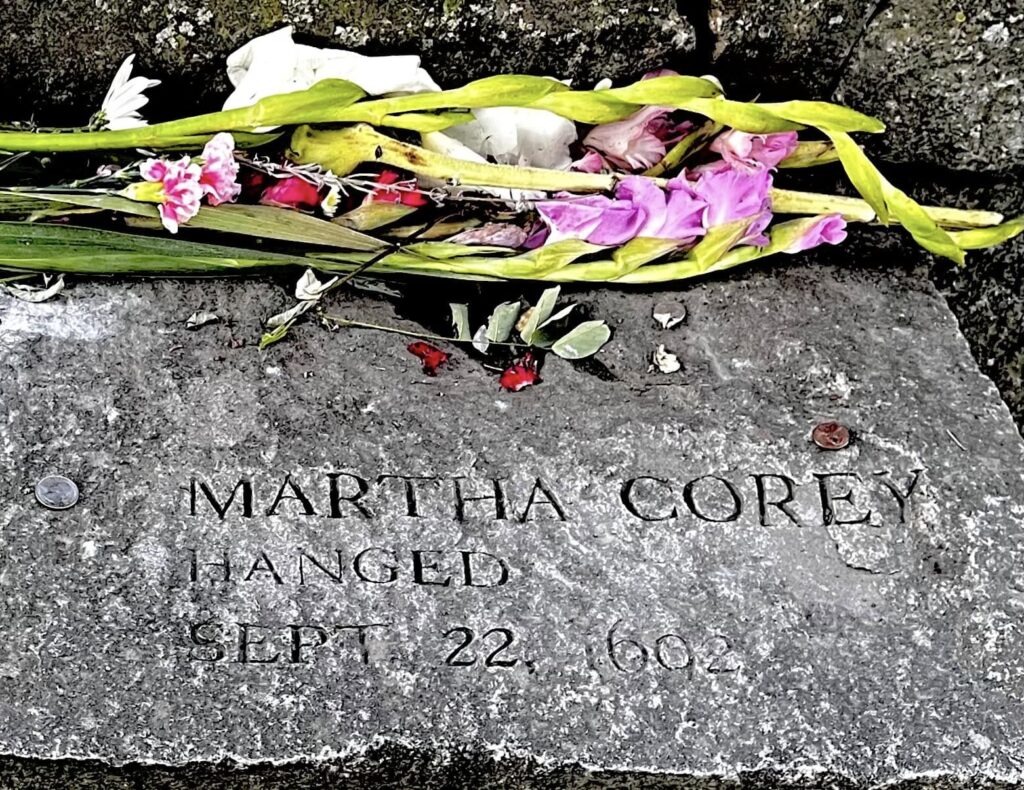
On September 22, 1692, Mary Esty was taken to Proctor’s Ledge and hanged with seven others, among them Martha Corey, Alice Parker, Mary Parker, Ann Pudeator, Wilmot Redd, Margaret Scott, and Samuel Wardwell. These were the final hangings of the Salem Witch Trials. The eyewitness Robert Calef recorded her last moments with her family:
“When she took her last farewell of her husband, children and friends, [she] was… as serious, religious, distinct and affectionate as could well be exprest, drawing tears from the eyes of almost all present.”
— Robert Calef, eyewitness, on Mary Esty’s execution, September 22, 1692
Even then, the cruelty wasn’t finished. As the eight bodies hung, Reverend Nicholas Noyes looked up and sneered, “What a sad thing it is to see eight firebrands of hell hanging there.” It was the voice of the trials at their most heartless, set against the quiet dignity of the woman and man they had just killed.
Her words outlived her
Mary Esty’s hanging was among the last. Within weeks, the court finally barred the spectral evidence that had condemned her, and the trials began to unravel. She did not live to see it, but her petition survives as one of the most powerful and clear-eyed documents of 1692, remembered alongside the martyrdom of her sister Rebecca. Two Towne sisters went to the gallows; their descendants, and history, have carried their names with pride ever since.
WALK HER STORY
Hear Mary Esty's story where it happened
Our historian-led 1692 Salem Historical Tour tells the true stories of Mary Esty and the other victims on the very streets where the trials unfolded. Two hours, all ages, $35 adults / $10 kids.
Frequently asked questions
Mary Esty (also spelled Easty or Eastey) was a devout farm wife from Topsfield, Massachusetts, and one of the twenty people executed during the 1692 Salem Witch Trials. She was a sister of Rebecca Nurse and Sarah Cloyce, and she was hanged on September 22, 1692.
Yes. Mary Esty was one of three Towne sisters accused of witchcraft. Her sister Rebecca Nurse was also hanged, and her sister Sarah Cloyce was accused but survived. Their mother, Joanna Towne, had been rumored to be a witch years earlier.
Mary Esty had a good reputation, so historians believe her accusation was driven largely by old grudges — particularly long-running feuds between her Towne family and the Putnams, who were the chief accusers — along with land disputes and the belief that witchcraft ran in families. Being a Towne made her a target.
After she was condemned to death, Mary Esty petitioned the governor and judges — not to save her own life, which she accepted was lost, but to beg that no more innocent people be executed. She urged the court to examine the afflicted girls separately and to question the confessing witches closely, arguing that many had lied. It is considered one of the most moving documents of the trials.
Mary Esty was hanged on September 22, 1692, at Proctor’s Ledge in Salem, alongside Martha Corey and six others — the last group executed in the Salem Witch Trials. Witnesses said her final farewell to her family moved nearly everyone present to tears.
Sources & further reading
This article draws on the original 1692 court records and firsthand accounts. To read the primary sources yourself:
- Mary Esty’s court records (SWP No. 45) — Salem Witch Trials Documentary Archive, University of Virginia.
- More Wonders of the Invisible World — Calef, Robert
- The Salem Witch Trials Documentary Archive and Transcription Project — the full collection of original court records and transcriptions from 1692.