Salem Witch Trials
Elizabeth Howe: The Accusation That Couldn’t Be Undone
By Lori, History writer & tour co-founder • October 2026 • 9 min read
A minister stood before the court and swore it under oath: the girl whose accusation would hang Elizabeth Howe had already taken it back. She had cleared Elizabeth to her face. The child, he said, had been coached by her own family. The judges heard every word, and sent Elizabeth Howe to the gallows anyway.
If you want to understand just how broken the Salem courtroom had become by the summer of 1692, her case is the one to study, and one we never skip on our Salem Witch Trials walking tour. Here, even sworn proof of innocence wasn’t enough to save a life.
ELIZABETH HOWE AT A GLANCE
WHO – A Topsfield farm wife, married to James Howe, who was blind
ACCUSED – First around 1682, then fatally in 1692
THE INJUSTICE – A minister testified the key accusation had been recanted and coached, and was ignored
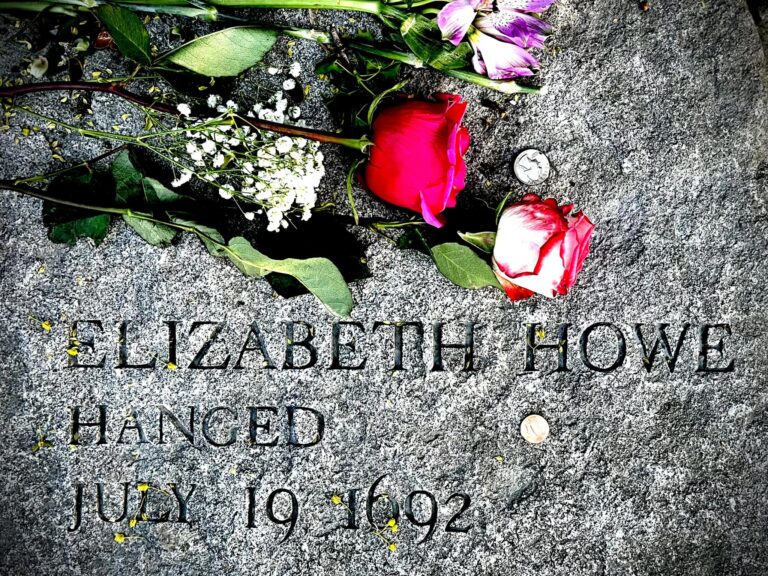
EXECUTED – Hanged at Proctor’s Ledge, July 19, 1692, with four other women
A farm family in Topsfield
Elizabeth Jackson was born near Rowley, England, in 1635, and came to Massachusetts as a child when her family became some of the earliest settlers of the new town of Rowley. In 1658 she married James Howe Jr., and together they raised six children on a farm along what is now Linebrook Road, near the Topsfield–Ipswich line. It was a hard, ordinary farming life, made harder still when James lost his sight at the age of fifty. By every early account, Elizabeth was a well-liked woman. That changed with a single quarrel.
The accusation that poisoned her name
Around 1682, after a falling-out between the Howes and a neighboring family, the Perleys, their roughly ten-year-old daughter began suffering fits and claimed she was being pricked with pins. A doctor pronounced her the victim of an “evil hand,” and the girl named Elizabeth Howe as the witch tormenting her. The child suffered for a few years and then died. Elizabeth was never arrested or charged, but the accusation clung to her like a stain.
When she later tried to join a church in Ipswich, members of the Perley family blocked her admission on the grounds that she might be a witch. The rejection only fed the rumors, and soon the familiar stories began: that Elizabeth Howe had bewitched this neighbor’s horse, that cow, those animals. A decade of quiet suspicion was building toward 1692.
Arrested on an old reputation
In May 1692, the afflicted girls of Salem Village turned their attention to Elizabeth Howe. A warrant was issued on May 29, and she was arrested that same day by the Topsfield constable, Ephraim Wildes, whose own mother, Sarah Wildes, would hang beside Elizabeth seven weeks later.
On May 31, she was brought to Ingersoll’s Tavern in Salem Village and examined by Judges John Hathorne and Jonathan Corwin, with Reverend Samuel Parris taking down the record. The instant she entered, the afflicted girls fell into fits and cried out that she had hurt them. Elizabeth’s answers never wavered:
“If it was the last moment I was to live, God knows I am innocent of any thing in this nature.”
— Elizabeth Howe at her examination, from the court record, May 1692
When the judges demanded to know how her mere glance could knock the girls down, she could only answer, again and again, “I cannot help it.” She was indicted on two charges of witchcraft and sent to jail.
A light in the window
What happened during her imprisonment is one of the most moving stories of the entire trials. Elizabeth’s husband James was blind, and their farm sat far from the main roads, yet twice every week, one of their daughters guided her father on horseback to the jail to visit her. The daughter would manage the horse, then take her blind father by the hand and lead him to his wife’s cell. One of the Howe daughters even rode all the way to Boston to beg the governor for a reprieve. She was refused. The family poured out everything they had in devotion to a woman they swore was as innocent as anyone alive.
The witness who tried to save her
Elizabeth’s trial opened on June 29, 1692. The old Perley grudge came roaring back; relatives and neighbors lined up to repeat the story of the dead girl and the bewitched animals. But something remarkable also happened: a respected minister took the stand for her.
Reverend Samuel Phillips of Rowley testified that he had been present with the afflicted Perley girl, and that she had cleared Elizabeth Howe to her face, saying Elizabeth had never hurt her. Worse, Phillips swore he had personally watched the girl’s own brother lean out a window and press her to accuse Elizabeth:
“Say Goodwife Howe is a witch, say she is a witch…” — which the minister rebuked him for, there and then.
— Rev. Samuel Phillips’s testimony, describing the coaching of the accuser, 1692
A second witness, Edward Payson, confirmed it. Here was sworn testimony, from a minister, that the central accusation had been recanted by the accuser and manufactured by her family. In any functioning court, it should have ended the case.
Grudges, and a flaming horse
Instead, the court leaned on the other witnesses, and their “evidence” was a parade of old farm misfortunes. Neighbors swore Elizabeth had bewitched a horse that fell ill after she asked to borrow it; one of the strangest accounts described a folk remedy involving a lit tobacco pipe that set the poor animal briefly ablaze and nearly burned down a barn (a scene we can now explain with simple barnyard chemistry). Even Elizabeth’s own brother-in-law testified against her, claiming she’d bewitched his pig after he refused to visit her in jail. It was gossip and grievance, stacked against a minister’s sworn word, and the gossip won.
July 19, 1692
The jury found Elizabeth Howe guilty. On the morning of July 19, 1692, she was taken to Proctor’s Ledge and hanged alongside four other women: Rebecca Nurse, Susannah Martin, Sarah Good, and Sarah Wildes, the first mass execution of the Salem Witch Trials. Somewhere on the road home, a blind farmer and his daughters absorbed the news that all their devotion had not been enough.
WHY HER CASE STILL MATTERS
When proof stops mattering
Most of the accused could offer only their word against the accusers’. Elizabeth Howe had more: a minister willing to swear that the accusation was false and coached. That the court hanged her anyway tells you everything about 1692. By that summer, the trials were no longer weighing evidence; they were confirming conclusions they’d already reached. That is the real horror of her story, and the warning it still carries.
WALK HER STORY
Hear Elizabeth Howe's story where it happened
Our historian-led 1692 Salem Historical Tour tells the true stories of Elizabeth Howe and the other victims on the very streets where the trials unfolded. Two hours, all ages, $35 adults / $10 kids.
Frequently asked questions
Elizabeth Howe (born Elizabeth Jackson, 1635) was a farm wife from Topsfield, Massachusetts, married to James Howe. She was one of the twenty people executed during the 1692 Salem Witch Trials, hanged on July 19, 1692.
Her troubles began around 1682, when a neighboring family’s daughter accused her of witchcraft after a falling-out. Though Elizabeth was never charged at the time, the accusation damaged her reputation for a decade, and when the Salem hysteria began in 1692, those old grudges and rumors resurfaced as formal charges.
Yes, and powerfully. Reverend Samuel Phillips of Rowley testified that the key accuser had recanted and cleared Elizabeth to her face, and that he had personally seen the girl’s brother coaching her to accuse Elizabeth. Several other neighbors also spoke in her defense. The court disregarded their testimony.
Elizabeth’s husband, James Howe, was blind, yet one of their daughters guided him on horseback to visit her in jail twice a week. A daughter even traveled to Boston to beg the governor for a reprieve, which was refused. The family’s devotion is one of the most remembered parts of her story.
Elizabeth Howe was found guilty of witchcraft and hanged on July 19, 1692, at Proctor’s Ledge in Salem, alongside Rebecca Nurse, Susannah Martin, Sarah Good, and Sarah Wildes — the largest single day of executions in the trials.
Sources & further reading
This article draws on the original 1692 court records and firsthand accounts. To read the primary sources yourself:
- Elizabeth Howe’s court records (SWP No. 72) — Salem Witch Trials Documentary Archive, University of Virginia.
- The Salem Witch Trials Documentary Archive and Transcription Project — the full collection of original court records and transcriptions from 1692.