Salem Witch Trials
George Jacobs Sr.: “Burn Me or Hang Me, I Will Stand in the Truth”
By Lori, History writer & tour co-founder • October 2026 • 10 min read
He was an old man, tall, white-haired, so infirm he leaned on two canes just to stand. His own servant had accused him. His own granddaughter would soon be forced to name him. And still, when the Salem court demanded that George Jacobs Sr. confess to witchcraft to save his life, he refused to tell a lie. “Burn me or hang me,” he told them. “I will stand in the truth of Christ.”
His is one of the most quietly heroic stories of 1692, and a favorite to tell on our Salem Witch Trials walking tour. It’s also one that ends, remarkably, with a long journey home — three centuries in the making.
SUSANNAH MARTIN AT A GLANCE
WHO – An elderly farmer of Salem Village (now Danvers) who walked with two canes
ACCUSED – In May 1692 — by his own household servant, Sarah Churchill, and other local girls
REMEMBERED FOR – His fearless defiance and the words now on his gravestone
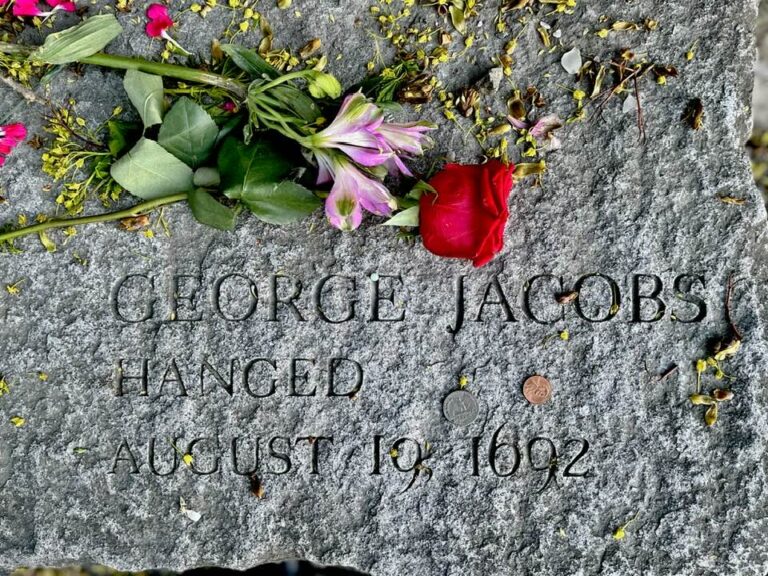
EXECUTED – Hanged at Proctor’s Ledge, August 19, 1692
FINALLY LAID TO REST – Reburied at the Rebecca Nurse Homestead in 1992
An old farmer of Salem Village
George Jacobs Sr. was born in 1620 and settled in Salem Village, today’s Danvers, where he bought a house and farmland near the Waters River in 1658. He married twice and raised children on that land. He was not a gentleman by reputation; records show he had a temper and was once fined for striking a neighbor. By 1692 he was elderly and frail, remembered as uncommonly tall, with long, thin white hair, walking on two staffs to get around. He had the bearing of a patriarch, and, as the court would discover, the stubbornness of one.
“Innocent as the child born tonight”
What followed at his examination is some of the sharpest testimony in the entire record. Jacobs did not cower. He laughed at the absurdity of the charges, turned the judges’ questions back on them, and never stopped protesting his innocence:
“I am as innocent as the child born tonight… You tax me for a wizard, you may as well tax me for a buzzard. I have done no harm.”
— George Jacobs Sr. at his examination, from the court record, May 1692
When the magistrate argued that the devil could not take Jacobs’s shape without his consent, Jacobs shot back that the devil could take any likeness he pleased. Then came a cruel test: ordered to recite the Lord’s Prayer, a test a “true witch” was supposed to fail, the old man stumbled. He could not remember it, and he missed parts of it after several attempts. It was held against him. Through all of it, his conviction never broke, and he ended with the words that would outlive him:
“Well, burn me, or hang me, I will stand in the truth of Christ. I know nothing of it.”
— George Jacobs Sr., from his examination — later carved on his gravestone
His canes turned into a weapon
The “evidence” against Jacobs was entirely spectral and grotesquely creative. Because he walked with two canes, accuser after accuser claimed that his spirit came to them and beat them with those very canes. At least six people swore to it. A jailer also testified to searching the old man’s body and finding a “witch’s mark.” It was his frailty itself, the canes that held him upright, recast as the instrument of his supposed cruelty. There was not one shred of real evidence; only the fits of the afflicted and the imaginations of a frightened town.
Margaret's courage
And yet, out of that wreckage came one of the bravest acts of the whole episode. Margaret Jacobs could not live with what she had done. She had confessed and accused her grandfather only because she was told it would save her life, and the guilt of it tormented her. So she did the unthinkable: she took it all back. Knowing a retraction could send her to the gallows, she declared her confession false and cleared her grandfather’s name, choosing, in her own words, death with a quiet conscience over life with a ruined one. It came too late to save George Jacobs, but it was his vindication, spoken by the granddaughter who had been forced to betray him.
August 19, 1692
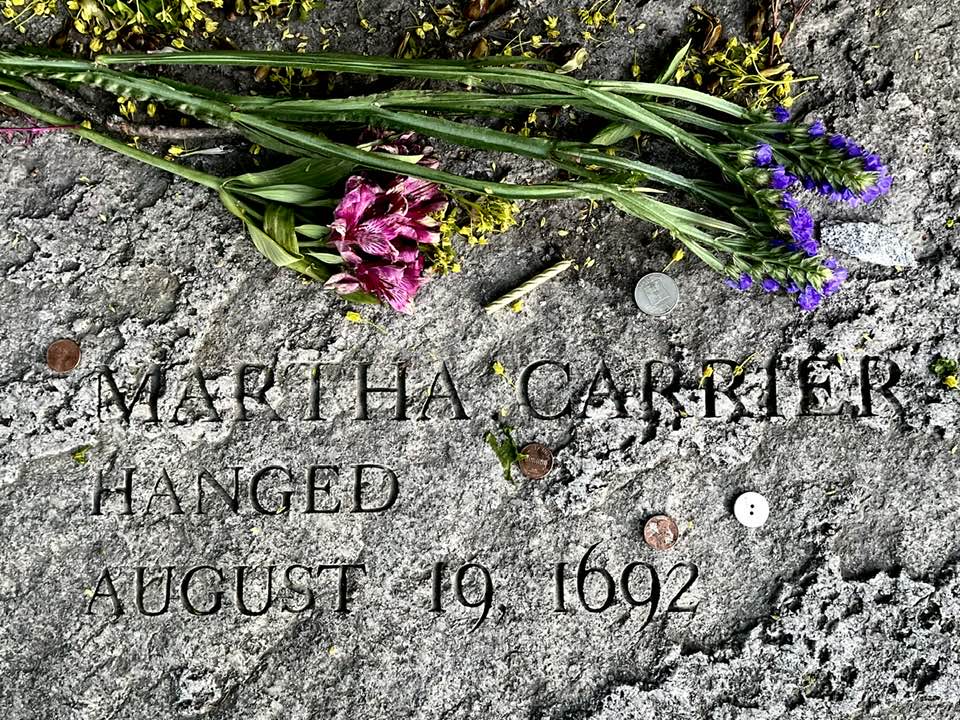
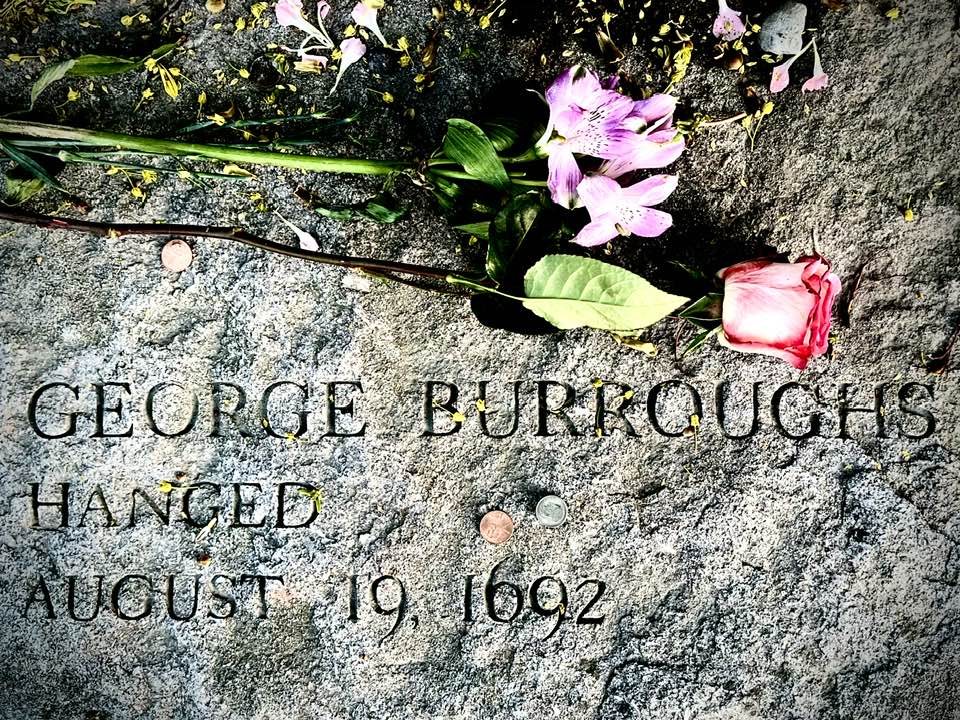
George Jacobs Sr. was convicted on August 5 and, on August 19, 1692, carried by cart to Proctor’s Ledge and hanged alongside four others: Reverend George Burroughs, John Proctor, John Willard, and Martha Carrier. He went to his death exactly as he had stood at his trial, insisting, to the last, on the truth.
A grandson, a horse, and a long way home
Jacobs’s story has an ending unlike that of almost any other victim. According to family tradition, after the execution, under the cover of darkness, his grandson strapped the old man’s body to the back of a horse and carried him home, burying him quietly beneath the trees of his own farm, the grave marked by two plain stones. There he lay for generations.
In 1864, remains were unearthed on the old Jacobs land, a very tall, toothless old man, exactly matching what the records said of him, and reverently reburied. Bulldozers uncovered the grave again in the 1950s when the farm was developed. The remains were held in storage till 1992, when he was laid to rest for good at the Rebecca Nurse Homestead in Danvers, in a replica 17th-century coffin, beneath a headstone carved with his own defiant words. Three hundred years after Salem tried to erase him, George Jacobs Sr. finally has a marked grave, and the last word is his.
Why His Story Endures
The man who would not lie to live
Many of the accused could have saved themselves with a false confession; the court was far more interested in confessions than in truth. George Jacobs refused. Old, frail, abandoned by a servant and forced to watch his family destroyed, he still would not say the words that might have spared him, because they weren’t true. That is why his own words, not his accusers’, are the ones carved in stone.
WALK HIS STORY
Hear George Jacobs's story where it happened
Our historian-led 1692 Salem Historical Tour tells the true stories of George Jacobs Sr. and the other victims on the very streets where the trials unfolded. Two hours, all ages, $35 adults / $10 kids.
Frequently asked questions
George Jacobs Sr. was an elderly farmer of Salem Village (now Danvers) and one of the twenty people executed during the 1692 Salem Witch Trials. Tall, white-haired, and so frail he walked with two canes, he was accused by his own household servant and hanged on August 19, 1692.
He was accused by his own servant, Sarah Churchill. The case against him was built entirely on spectral evidence, including repeated claims that his spirit beat his victims with his walking canes. His sharp tongue and open skepticism of the afflicted girls likely made him a target as well.
At his examination, George Jacobs declared, “Well, burn me, or hang me, I will stand in the truth of Christ. I know nothing of it.” Those words are now engraved on his gravestone at the Rebecca Nurse Homestead.
His whole family was swept up. His granddaughter Margaret was pressured into confessing and naming him, then bravely recanted; his son George Jr. fled the country; his daughter-in-law Rebecca, who was mentally ill, was jailed in irons for months before being acquitted.
His family secretly buried him on his own farm after the execution. His remains were rediscovered in the 19th and 20th centuries and, in 1992, reburied at the Rebecca Nurse Homestead in Danvers, Massachusetts, beneath a headstone carved with his own words.
Sources & further reading
This article draws on the original 1692 court records and firsthand accounts. To read the primary sources yourself:
- George Jacobs Sr.’s court records (SWP No. 78) — Salem Witch Trials Documentary Archive, University of Virginia.
- The Salem Witch Trials Documentary Archive and Transcription Project — the full collection of original court records and transcriptions from 1692.