Salem Witch Trials
John Willard: The Constable Who Refused to Arrest the Innocent
By Lori, History writer & tour co-founder • October 2026 • 9 min read
His job was to bring the accused to jail. For a time, he did it. But when the court kept sending John Willard to arrest people he believed in his heart were innocent, something in him broke. He quit his job as a Constable, and within days, the machine he once served turned on him.
Willard’s story is one of the most quietly conscience-stirring of 1692, and one we’re always drawn to on our Salem Witch Trials walking tour. It asks a hard question: what does it cost to say no when everyone around you has said yes?
JOHN WILLARD AT A GLANCE
WHO – A Salem Village deputy constable and outsider who married into the Wilkins family
THE TURNING POINT – He quit arresting the accused after doubting their guilt
ACCUSED – Within days of walking away — by Ann Putnam Jr.
ALONE – Not a single person testified in his defense
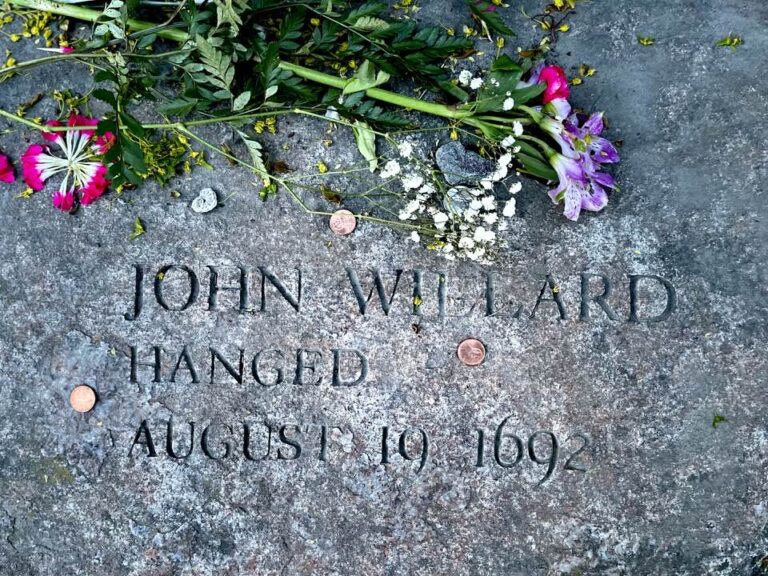
EXECUTED – Hanged at Proctor’s Ledge, August 19, 1692
An outsider who married up
John Willard was about thirty in 1692 and came from Groton, a frontier town some forty miles from Salem. He married Margaret Wilkins, a young woman from a large, long-established farming family in a remote western corner of Salem Village. In the eyes of that family, Willard was exactly what one historian has called him: “a young, upwardly mobile outsider who married into an established Salem Village family.” He had no interest in farming, and when he turned instead to land speculation, buying a large tract, carving it into lots, and selling them at a tidy profit, which angered the Wilkins family. Some sources suggest his grandfather-in-law, Bray Wilkins, may even have been jealous. That resentment would matter.
The constable who said no
When the hysteria began, Willard was a deputy constable, one of the men whose duty was to track down and arrest the accused. And at first, by one account, he seemed to go along with it; a neighbor later claimed Willard had said the accused “are all witches.” But something changed. According to Robert Calef in his book, More Wonders on the Invisible World, after Willard was sent to fetch people he believed were innocent, his conscience turned, and he simply quit:
“Taking dissatisfaction from his being sent to fetch up some that he had better thoughts of, he declined the service; and presently after he himself was accused.”
— Robert Calef, on John Willard leaving his post, 1692
It was a dangerous thing to do. In the Salem of 1692, to step away from the hunt was to invite suspicion that you were protecting the devil’s own. Within days, that suspicion found him.
Accused within days
At the end of April, Ann Putnam Jr. cried out that John Willard’s spirit was tormenting her. Hearing the rumor, Willard went straight to the Putnam house to confront her. She repeated the charge, and, in a chilling glimpse of how the accusations worked, offered him a bargain: if he stopped afflicting her, she would stop naming him. He denied doing anything and left. Her fits paused for a few days, then conveniently resumed.
A family turned against him
Then his wife’s own family became his undoing. At a dinner near Boston, Willard reportedly gave old Bray Wilkins a hard look, and Wilkins promptly fell ill, convinced he’d been bewitched. Back in Salem Village, Wilkins’s grandson Daniel lay gravely sick and soon died; a coroner’s jury ruled he had been killed by witchcraft. When the afflicted girls were brought in to name the culprit, they pointed to John Willard. The land resentment, the family grudges, and the hysteria had fused into something lethal.
On the run
When the arrest warrant came on May 10, Willard was already gone. He fled roughly forty miles before he was finally caught and dragged back. His flight would be used against him as proof of guilt, though, as he would tell the court, a frightened innocent man might run just as readily as a guilty one. The accusers, of course, claimed to have known the very moment he was seized.
“Make me as white as snow”
At his examination on May 18, recorded by Reverend Samuel Parris, the magistrate pressed him on his flight. Willard’s answer held both fear and faith:
“For my flying away… I was affrighted, and I thought by my withdrawing it might be better. I fear not but the Lord in his due time will make me as white as snow.”
— John Willard at his examination, from the court record, May 1692
The court piled on everything it had. He was accused not only of witchcraft but of murder, and witnesses also claimed he had beaten his wife, Margaret. The trials spared no one’s reputation. When Willard tried to answer at length, the magistrate cut him off coldly: “We do not send for you to preach.” Urged one last time to confess, he refused: “If it was the last time I was to speak, I am innocent.”
Not one defender
Willard was indicted on seven counts of witchcraft. At his trial, a long line of witnesses accused his spirit of tormenting and even murdering people; a spectral confession attributed to him listed a dozen victims, including the Putnams’ own infant daughter. Of all the accused in 1692, Willard may have been the most alone: not a single person stood up to testify in his defense. The family he had married into had become his accusers, and no one else dared speak for a man who had walked away from the witch hunt.
August 19, 1692
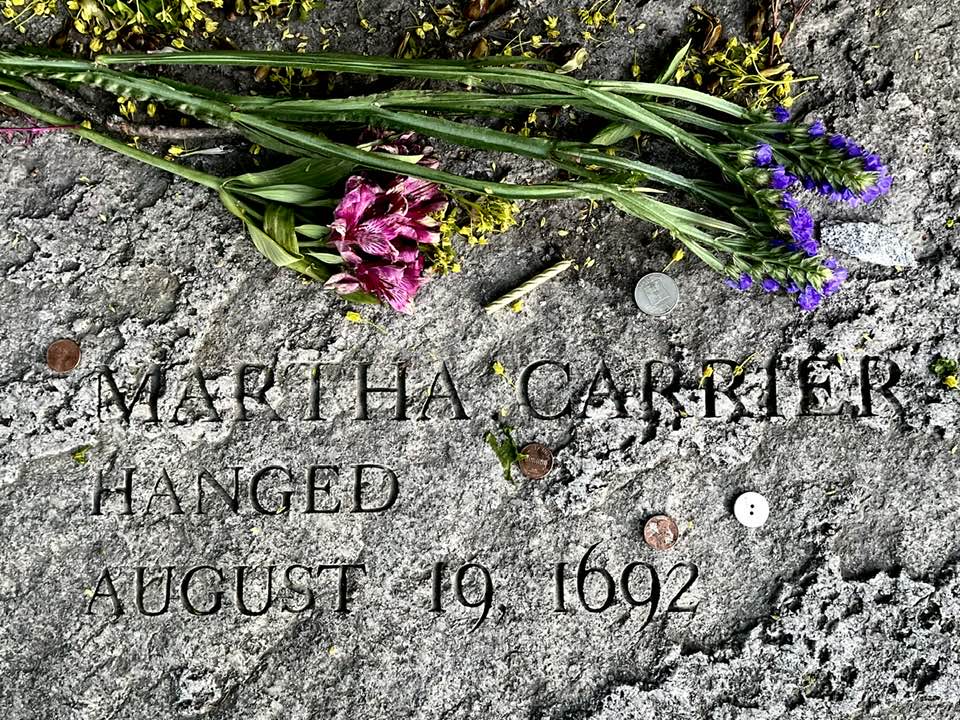
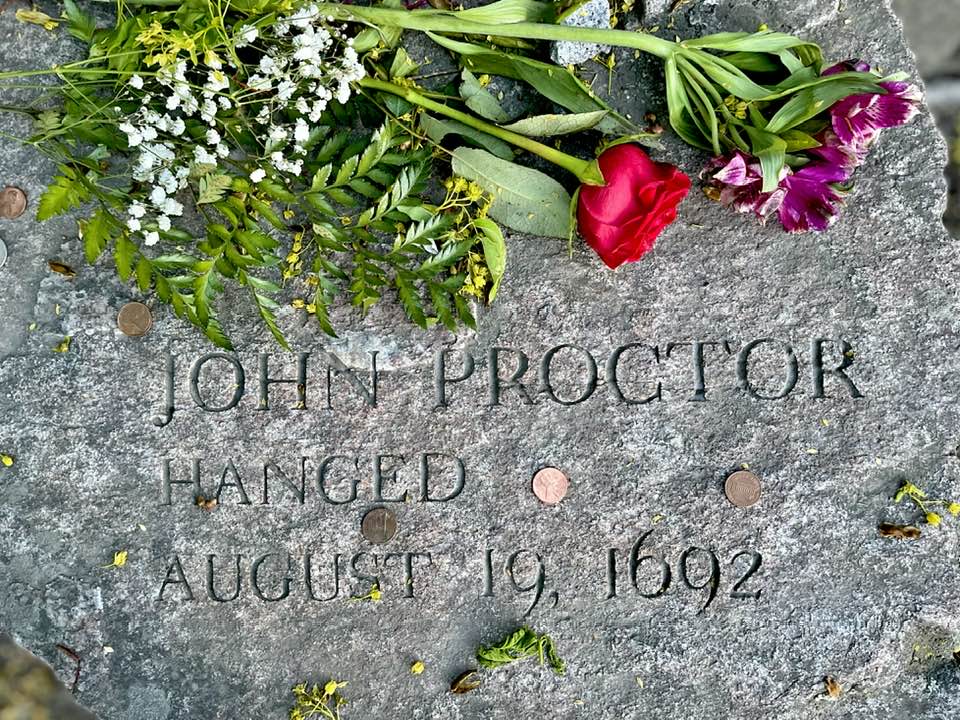
John Willard was convicted on August 5 and, on August 19, 1692, taken to Proctor’s Ledge and hanged alongside four others: Reverend George Burroughs, John Proctor, George Jacobs Sr., and Martha Carrier. He went to his death as he had stood at his trial, insisting on his innocence and refusing to lie to save himself.
A QUIET REDEMPTION
His widow found the Townes
There’s a small grace note at the end of Willard’s story. Two years after his execution, his widow Margaret married William Towne, a nephew of three of the trials’ most famous victims, the Towne sisters: Rebecca Nurse, Sarah Cloyce, and Mary Esty. A woman widowed by the hysteria found a new family that had been shattered by it too. And in 1711, when Massachusetts began clearing the victims’ names, John Willard’s was among them, and Margaret received restitution for all she had lost.
WALK HIS STORY
Hear John Willard's story where it happened
Our historian-led 1692 Salem Historical Tour tells the true stories of John Willard and the other victims on the very streets where the trials unfolded. Two hours, all ages, $35 adults / $10 kids.
Frequently asked questions
John Willard was a Salem Village deputy constable and one of the twenty people executed during the 1692 Salem Witch Trials. An outsider who had married into the established Wilkins family, he was hanged on August 19, 1692.
Willard was a constable who grew to doubt the accusations and quit arresting the accused in protest, which turned suspicion onto him. Long-running resentment from his wife’s family, the Wilkinses — fueled by his land-speculation success and a series of illnesses and deaths in the family — helped drive the formal charges against him.
Yes. When the arrest warrant was issued in May 1692, Willard fled roughly forty miles from Salem before he was caught and brought back. His flight was used against him in court as supposed proof of guilt, though he testified that he ran out of fear, not guilt.
No. Willard was one of the most isolated of all the accused — numerous people testified against him, including his own in-laws, and not a single person testified in his defense.
John Willard was found guilty on August 5, 1692, and hanged on August 19, 1692, at Proctor’s Ledge in Salem, alongside George Burroughs, John Proctor, George Jacobs Sr., and Martha Carrier. His name was cleared in 1711.
Sources & further reading
This article draws on the original 1692 court records and firsthand accounts. To read the primary sources yourself:
- John Willard’s court records (SWP No. 137) — Salem Witch Trials Documentary Archive, University of Virginia.
- More Wonders of the Invisible World — Calef, Robert
- The Salem Witch Trials Documentary Archive and Transcription Project — the full collection of original court records and transcriptions from 1692.