Salem Witch Trials
Alice Parker: The Fisherman's Wife Hanged Over Old Grudges
By Lori, History writer & tour co-founder • October 2026 • 9 min read
A broken promise to mow some hay. A sailor who never came home from sea. A sick woman found lying in the snow. These were the “crimes” that hanged Alice Parker. In 1692 Salem, a blunt fisherman’s wife with poor health and a sharp tongue had everything she needed to be called a witch, and nothing at all to protect her.
Her case is one of the clearest windows into how the trials really worked, and one we return to often on our Salem Witch Trials walking tour. Strip away the talk of poppets and specters, and what condemned Alice Parker was the ordinary misfortune of a hard seafaring life.
ALICE PARKER AT A GLANCE
WHO – A Salem fisherman’s wife, married to John Parker
ACCUSED – By Mary Warren, in May 1692
THE “EVIDENCE” – Old grudges, deaths at sea, and her own apparent illness
TRIED – Her case rested entirely on spectral evidence and neighborhood rumor
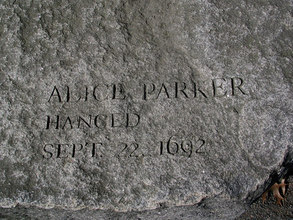
EXECUTED – Hanged September 22, 1692 — the final hangings
A life by the water
Alice Parker was married to a Salem fisherman named John Parker, and the couple rented a house on English Street, down in the bustling heart of the town’s waterfront. Beyond that, much of her early life goes unrecorded. Alice was an ordinary woman of the seafaring working class, the kind of person history rarely notices until something terrible happens to her. In 1692, something terrible did.
Accused by a fellow "witch"
The accusation came from an unexpected direction. Mary Warren, the former servant of John Proctor, who had herself been swept into the trials, named Alice Parker during her own examination in May 1692, claiming Parker had confessed to being a witch for a dozen years and had taught her to torment people with a poppet. Parker was arrested that same day, along with Ann Pudeator, and brought before the court.
“I never saw her”
At her examination, Alice Parker gave the court nothing. She pleaded not guilty to every charge and flatly denied she even knew her accuser:
“I never spoke a word to her in my life… I never saw her.”
— Alice Parker at her examination, from the court record, May 1692
When the marshal who arrested her claimed she had muttered that there were “threescore witches”, sixty of them, abroad in the land, Parker didn’t deny saying it, only that she couldn’t recall the number. And she had a sharp edge of her own: when one of the afflicted girls’ tongues reportedly stretched out and turned black during a fit, Parker remarked coldly that the girl’s tongue would be blacker still before she died. It was not the demeanor the court wanted from a woman pleading for her life, but it was the voice of someone who had stopped expecting fairness.
Grudges dressed up as witchcraft
The case against Alice Parker was a catalog of petty grievances recast as the devil’s work. Peel back the “spectral evidence,” and you find ordinary neighbors nursing ordinary resentments:
- Mary Warren’s father had promised to mow Parker’s hay and never did; when Parker came to complain, illness later struck the Warren household and was blamed on her.
- A man named John Westgate had quarreled with Parker in a tavern after she scolded her husband for drinking; walking home, he was startled by a black hog, fell, and cut himself, and decided the hog had been Parker in disguise.
This was the machinery of the trials in miniature: a grudge, a stroke of bad luck, and a frightened mind connecting the two.
The sea, turned against her
As a fisherman’s wife, Alice Parker knew what every waterfront family knew: that the sea took men and often didn’t give them back. When she told a neighbor bluntly that the woman’s seafaring husband would not return, and he indeed died abroad, it was not prophecy. It was the grim arithmetic of a dangerous trade. But in 1692, the court heard it as murder by witchcraft, and piled on a list of other men said to have drowned at Parker’s invisible hand. The honest fatalism of a sailor’s wife had become evidence of a pact with the devil.
A sick woman, not a witch
Perhaps the most heartbreaking detail is this: Alice Parker was almost certainly unwell. One neighbor testified to finding her collapsed and unconscious in the snow one January, only for her to wake suddenly and laugh; another confirmed she had been seen in that state several times. To modern eyes, this reads plainly as a chronic medical condition, fainting spells, perhaps a seizure disorder. To her neighbors in 1692, a woman who dropped senseless and then revived was not sick. She was possessed, or worse. Her illness, which should have drawn compassion, helped hang her.
A whiff of heresy
There may have been one more mark against her. Reverend Nicholas Noyes suggested to her face that Alice Parker was a heretic, recalling that during an illness she had said something to the effect that if she were as free from other sins as from witchcraft, she would never need to beg God’s mercy. To the ministers, that sounded like a woman denying the doctrine of inborn sin, a dangerous unorthodoxy. As with Reverend Burroughs, a hint of religious nonconformity seems to have sharpened her prosecutors’ zeal.
September 22, 1692
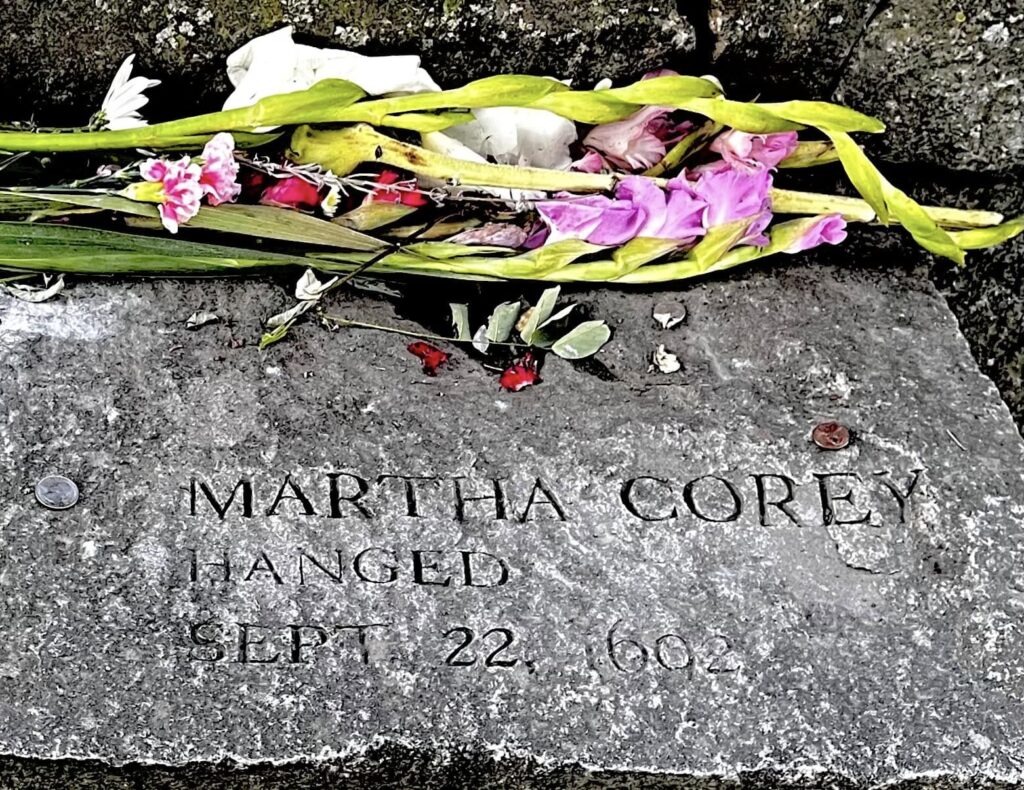
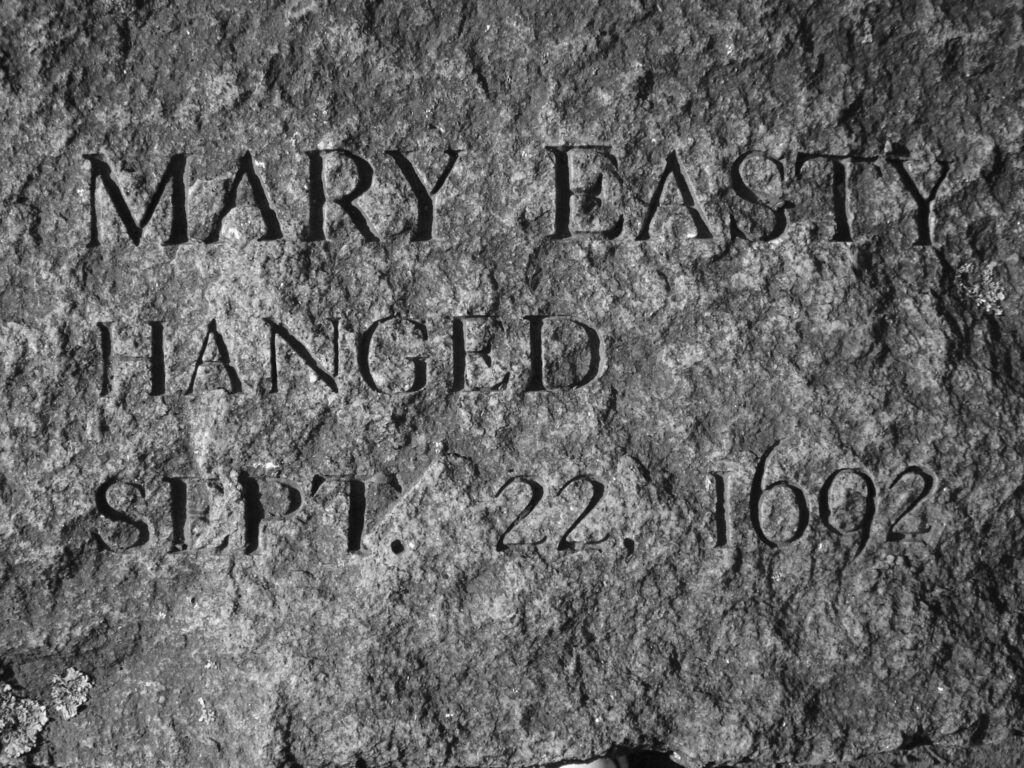
After a second examination in September, Alice Parker was tried on September 9 and found guilty. On September 22, 1692, she was carried by cart to Proctor’s Ledge with seven others: Mary Esty, Martha Corey, Ann Pudeator, Mary Parker, Wilmot Redd, Margaret Scott, and Samuel Wardwell, in what became the last hangings of the Salem Witch Trials. Witnesses recalled the cart sticking fast on the steep hill, with the accusers crying that the devil was holding it back. All eight prisoners declared their innocence to the end. As their bodies hung, Reverend Noyes looked up and sneered, “What a sad thing it is to see eight firebrands of hell hanging there.”
JUSTICE THREE CENTURIES LATE
The name that waited until 2001
When Massachusetts began clearing the victims’ names and paying restitution in 1711, no relative stepped forward for Alice Parker, and so her conviction was simply left standing. She was one of a small handful of the executed whose names the colony never got around to clearing. It would take more than three hundred years: not until October 31, 2001, did Massachusetts finally, formally exonerate Alice Parker. A woman hanged on gossip and grief had to wait three centuries to be called innocent.
WALK HER STORY
Hear Alice Parker story where it happened
Our historian-led 1692 Salem Historical Tour tells the true stories of Alice Parker and the other victims on the very streets where the trials unfolded. Two hours, all ages, $35 adults / $10 kids.
Frequently asked questions
Alice Parker was the wife of a Salem fisherman, John Parker, and one of the twenty people executed during the 1692 Salem Witch Trials. She was hanged on September 22, 1692, in the final group of executions.
The case against Alice Parker was entirely spectral evidence and neighborhood rumor. Witnesses blamed her for illnesses and deaths at sea, pointed to old grudges over things like unmowed hay, and treated her apparent fainting spells as supernatural. There was no physical or factual evidence of any crime.
Alice Parker was accused by Mary Warren, and the case against her was built from old grudges and misfortunes — a quarrel over unmowed hay, a tavern dispute, deaths at sea that she had bluntly predicted, and her own apparent fainting spells. In the fearful climate of 1692, these ordinary troubles were treated as proof of witchcraft.
Very late. Because no relative petitioned for her in 1711, her conviction was left in place for centuries. Alice Parker was not officially exonerated until October 31, 2001, more than 300 years after her execution.
Alice Parker was hanged on September 22, 1692, at Proctor’s Ledge in Salem, alongside Mary Esty, Martha Corey, Ann Pudeator, and four others — the last group executed during the Salem Witch Trials.
Sources & further reading
This article draws on the original 1692 court records and firsthand accounts. To read the primary sources yourself:
- Alice Parker’s court records (SWP No. 97) — Salem Witch Trials Documentary Archive, University of Virginia.
- The Salem Witch Trials Documentary Archive and Transcription Project — the full collection of original court records and transcriptions from 1692.