Salem Witch Trials
Sarah Wildes: The Accusations That Sent Her to the Gallows
By Lori, History writer & tour co-founder • October 2026 • 9 min read
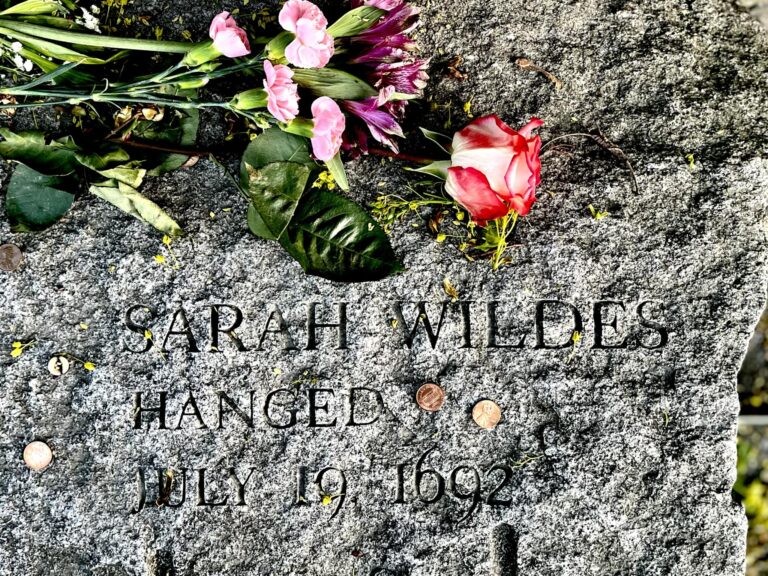
Sarah Wildes was not hanged because anyone truly believed she was a witch. She was hanged because, nearly thirty years earlier, she had married a widower too soon, and his dead wife’s family never forgave her. In 1692, that old resentment finally found the one weapon that could end a life: an accusation of witchcraft.
Her story is one of the clearest proofs of something we return to again and again on our Salem Witch Trials walking tour: the trials were rarely about the supernatural. They were about grudges, land, and revenge, dressed up in the language of the devil.
SUSANNAH MARTIN AT A GLANCE
WHO – A Topsfield woman, second wife of local carpenter John Wildes
ACCUSED – April 1692, swept up with several of her own family members
REAL CAUSE – A decades-old family feud, a land dispute, and revenge for her son’s actions
EXECUTED – Hanged at Proctor’s Ledge, July 19, 1692, with four other women
A woman who didn't fit the mold
Sarah Averill was born around 1627 in Chipping Norton, England, and came to the Massachusetts Bay Colony as a child when her family settled in Ipswich. Even before 1692, she had a history that set tongues wagging. As a young woman she was sentenced to a whipping for a relationship outside of marriage, and years later she was cited for the very Puritan offense of wearing a silk scarf, a small act of vanity that broke the colony’s strict dress laws. In a community that prized conformity, Sarah had already been marked as someone who lived a little outside the lines.
The marriage that made an enemy for life
In November 1663, Sarah married John Wildes, a Topsfield carpenter and widower with seven children. His first wife, Priscilla Gould, had died only that spring. By the standards of the day the remarriage wasn’t especially hasty, but it didn’t matter. Priscilla’s brother and sister, John Gould and Mary Gould Reddington, took the new marriage as an insult and turned on Sarah with a hatred that never cooled.
What makes it chilling is how long that hatred lasted. The bad blood ran for years, and even after Mary Reddington herself died of natural causes, her friends kept the feud alive, repeating old stories and whispering that Sarah Wildes was a witch. A grudge that began at a wedding would, nearly three decades later, follow Sarah all the way to the gallows.
On the wrong side of a land war
Sarah had another mark against her, too. The Wildes family was tied to the Topsfield faction in a bitter, long-running land dispute with Salem Village, the same Salem Village that produced so many of the accusers in 1692. When the accusations began to fly, families on the wrong side of that feud made especially tempting targets.
Arrested — along with her family
On April 21, 1692, Thomas Putnam and John Buxton filed a complaint of witchcraft naming Sarah Wildes and a cluster of others. She was arrested the next day and examined by Judges John Hathorne and Jonathan Corwin. The accusers didn’t stop with her: her stepdaughter, Sarah Bishop, and her husband, Edward Bishop, were seized the same day, and so was another of John Wildes’s daughters. The net was closing around the whole household.
Only fragments of Sarah’s examination survive. We know that an afflicted young woman claimed to see her spirit perched on a beam of the meetinghouse, and that when the judges pressed her, Sarah answered simply and steadily:
“I am not guilty, sir… I never saw the book in my life, and I never saw these persons before.”
— Sarah Wildes at her examination, from the court record, April 1692
A confession turns the knife
Soon after, a woman named Deliverance Hobbs confessed to being a witch and named Sarah Wildes as one of her accomplices. Hobbs described a secret gathering of witches in a pasture near Reverend Parris’s house, led by the minister George Burroughs, and claimed Sarah had urged her to sign the devil’s book in exchange for clothes.
But there was a very earthly reason Hobbs might have pointed at the Wildes family. Sarah’s own son, Constable Ephraim Wildes, had been the one to arrest Deliverance Hobbs and her husband. Ephraim was certain her accusation was payback aimed at him. As he later put it in his testimony, he had seen “revenge in her face” when he made the arrest.
A trial built on ancient grudges
Sarah’s trial opened on June 29, 1692. A long line of witnesses testified against her, but as later historians have noted, almost all of them were family and friends of Priscilla Gould, recycling grievances that were often more than a decade old. The “evidence” was a catalog of ordinary misfortunes blamed, after the fact, on Sarah:
- Two men who had taken a scythe without her permission claimed their oxen later bolted and overturned their hay cart, and decided Sarah had cursed them.
- A woman said that after arguing with Sarah, a spectral cat lay on her through the night, and that she suffered mysterious back pain ever after.
- Another recalled a relative being dragged off her horse into a creek years before, by Sarah’s invisible shape.
- A farmer blamed the deaths of his cattle and geese on a beehive he’d once sold her.
None of it was evidence of anything but long memories and old anger. Yet in that courtroom, it was treated as proof.
The two who stood by her
Against all of it, only two people spoke in Sarah’s defense: her husband John and her son Ephraim. John revealed that years before, he’d threatened to have Mary Reddington arrested for defamation over the witch rumors, only to hold off when her own husband begged him not to ruin the family. Ephraim testified twice, insisting the whole case was an act of revenge by the Reddingtons and their circle. He closed with a son’s plain, heartbreaking defense of his mother:
“She hath always instructed me well in the Christian religion and the ways of God ever since I was able to take instructions.”
— Ephraim Wildes, testifying for his mother, 1692
It wasn’t enough. The jury found Sarah Wildes guilty, and she was sentenced to hang.
July 19, 1692
On that summer morning, Sarah Wildes was taken to Proctor’s Ledge and hanged alongside four other women: Rebecca Nurse, Susannah Martin, Elizabeth Howe, and Sarah Good. It was the first mass execution of the trials. Afterward, the bodies were cut down and pushed into a rocky crevice near the ledge. As convicted “witches,” they were denied a proper burial, and what became of Sarah’s remains is unknown to this day.
THE REAL LESSON OF HER STORY
Fear gave old enemies a weapon
Strip away the talk of spectral cats and the devil’s book, and Sarah Wildes’s death is painfully simple to understand. A grudge that began with a marriage, a quarrel over land, and a son who arrested the wrong people, in any other year, these were the ordinary frictions of village life. In 1692, they were enough to kill. That’s the warning her story still carries: when a community stops demanding real evidence, old grievances become fatal.
WALK HER STORY
Hear Sarah Wildes story where it happened
Our historian-led 1692 Salem Historical Tour tells the true stories of Sarah Wildes and the other victims on the very streets where the trials unfolded. Two hours, all ages, $35 adults / $10 kids.
Frequently asked questions
Sarah Wildes (born Sarah Averill, around 1627) was a woman from Topsfield, Massachusetts, and the second wife of local Carpenter John Wildes. She was one of the twenty people executed in the 1692 Salem Witch Trials, hanged on July 19, 1692.
Her accusation grew out of long-running personal grudges rather than any real evidence. The relatives of her husband’s first wife had resented Sarah for decades, her family was on the wrong side of a Topsfield–Salem Village land dispute, and her son, a constable, had arrested one of the women who went on to accuse her. Most of the trial testimony came from those same resentful families.
Only two people: her husband, John Wildes, and her son, Constable Ephraim Wildes. Ephraim testified twice that the accusations were an act of revenge, and described his mother as a good Christian who had raised him in the faith.
Sarah Wildes was found guilty of witchcraft and hanged on July 19, 1692, at Proctor’s Ledge in Salem, alongside Rebecca Nurse, Susannah Martin, Elizabeth Howe, and Sarah Good. It was the largest single day of executions during the trials.
Yes. On the same day Sarah was arrested, her stepdaughter and that woman’s husband, Edward Bishop, were also seized, along with another of John Wildes’s daughters. The accusations targeted much of the Wildes household at once.
Sources & further reading
This article draws on the original 1692 court records and firsthand accounts. To read the primary sources yourself:
- Sarah Wildes’s court records (SWP No. 136) — Salem Witch Trials Documentary Archive, University of Virginia.
- The Salem Witch Trials Documentary Archive and Transcription Project — the full collection of original court records and transcriptions from 1692.