Salem Witch Trials
Wilmot Redd: The Woman Behind Marblehead's “Mammy Redd” Legend
By Lori, History writer & tour co-founder • October 2026 • 9 min read
Long before Salem’s accusers ever spoke her name, the fishing town of Marblehead already had its witch. They called her “Mammy Redd,” and told one another dark stories of curdled milk and curses laid on the cradles of children. But peel away three centuries of folklore, and Wilmot Redd was something far more ordinary, and far sadder: a disliked old fisherman’s wife, hanged on a grudge and a girl’s say-so.
Hers is one of our favorite stories to untangle on the Salem Witch Trials walking tour, because she’s the rare victim who became a bona fide ghost legend. And as always in 1692, the real history turns out to be more unsettling than the spooky tale that replaced it.
WILMOT REDD AT A GLANCE
WHO – A Marblehead fisherman’s wife — the only person from Marblehead hanged in 1692
HER REPUTATION – “Mammy Redd,” a feared village “witch” for years before Salem
ACCUSED – May 1692, by the afflicted girls of Salem Village
THE “EVIDENCE” – Spectral claims and a single crude curse over stolen linen
EXECUTED – Hanged September 22, 1692 — the final hangings
The witch of Marblehead
Wilmot Redd lived in Marblehead with her husband Samuel, a fisherman, in a small house beside Old Burial Hill, at the edge of what the town still calls Redd’s Pond. We know almost nothing certain about her family or her early life. What survives instead is her reputation. For years, Marblehead had muttered about “Mammy Redd,” an unpopular old woman many believed held supernatural powers. Local lore credited her with all the classic curses of a village witch: souring the milk in the pail, spoiling a neighbor’s butter, and worse, wishing harm onto the children of people who crossed her.
Here’s the telling part, though: for all the fear, Marblehead itself never had her arrested. Her neighbors grumbled and told their stories, but they left her alone. It took the accusing girls of Salem Village, miles away, to turn a town’s old gossip into a death sentence.
The only Marbleheader accused
In late May 1692, the afflicted girls, Ann Putnam Jr., Mary Walcott, and Mercy Lewis, named Wilmot Redd as one of their tormentors. A warrant followed, and she was arrested by the Marblehead constable and brought to Salem. In the whole sprawl of the witch trials, Wilmot Redd holds a grim distinction: she was the only person from Marblehead to be tried and executed.
“They are in a sad condition”
At her examination on May 31, the usual scene unfolded: the girls collapsed at the sight of her, accused her of pinching them and pushing the devil’s book at them, and were “cured” by the touch test. But when the judges pressed Redd to say what she thought was wrong with the girls, she refused to play along or condemn them. Her answer was oddly, memorably human:
“My opinion is they are in a sad condition.”
— Wilmot Redd at her examination, from the court record, May 1692
Asked again and again whether the girls were bewitched, all she would say was “I cannot tell.” It was not the answer of a confident witch, nor of a frightened confessor, just a wary old woman who would neither accuse herself nor join the hysteria.
A curse over stolen linen
Her trial, in mid-September, had surprisingly little to work with. Several summoned witnesses never appeared; some were out at sea, one was too ill to come, and beyond the afflicted girls, only a handful testified. The one piece of “evidence” that wasn’t pure spectacle was an old grudge. Years earlier, a woman named Mrs. Syms had suspected Redd’s servant of stealing some linen and threatened to get a warrant. According to the testimony, Redd answered with a crude curse, wishing the woman would lose the ability to relieve herself, and soon after, Mrs. Syms fell ill with a painful stomach pain that lingered for months. On that story, and on the girls’ insistence that “in my heart” they believed her a witch, Wilmot Redd was condemned.
September 22, 1692
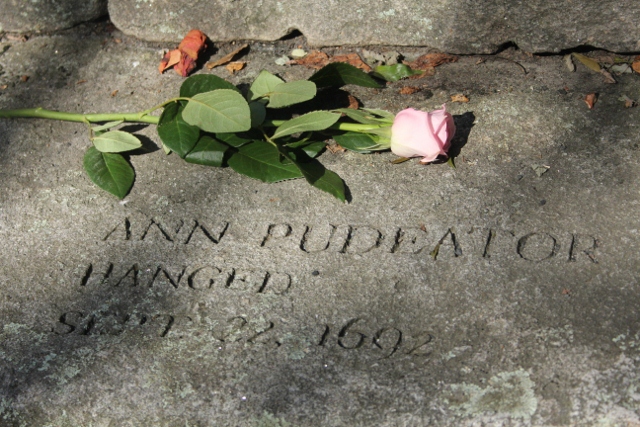
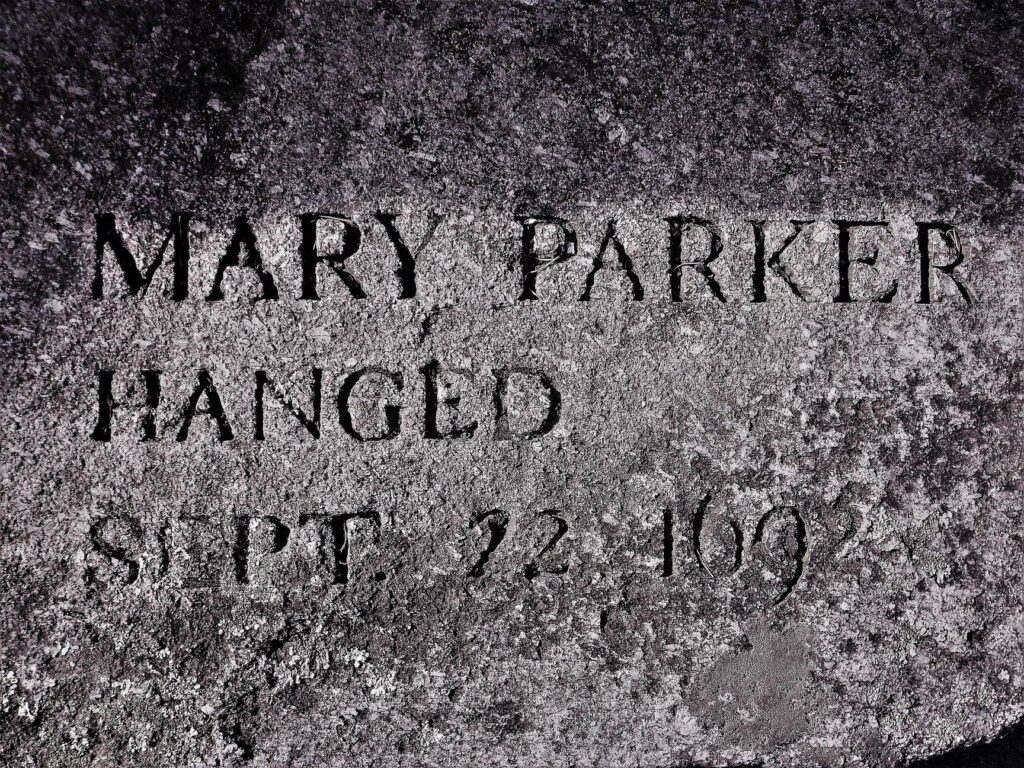
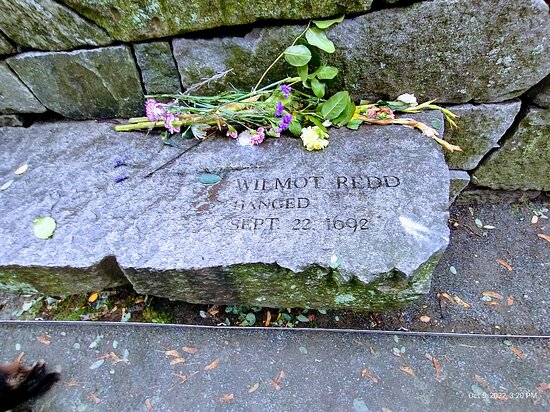
On September 22, 1692, Wilmot Redd was carried by cart to Proctor’s Ledge with seven others, among them Mary Esty, Martha Corey, Ann Pudeator, Alice Parker, Mary Parker, Margaret Scott, and Samuel Wardwell, in what became the last hangings of the Salem Witch Trials. The cart stuck fast on the hill, and the accusers cried that the devil was holding it back. All eight prisoners declared their innocence to the end. As the bodies hung, Reverend Nicholas Noyes delivered his infamous remark: “What a sad thing it is to see eight firebrands of hell hanging there.”
Cleared in 2001 — haunting ever since
Justice came painfully slowly. No relative stepped forward to clear Wilmot Redd’s name in 1711, so her conviction stood, untouched, through the centuries. She was one of a small group of the executed whom Massachusetts didn’t formally exonerate until October 31, 2001, more than three hundred years after her death. In 1998, the town of Marblehead placed a cenotaph in her memory at Old Burial Hill, beside her husband’s grave. Her own grave has never been found.
THE LEGEND AND THE WOMAN
"Mammy Redd" still walks — but who was she, really?
To this day, Marblehead swears Wilmot Redd never left. Locals say her ghost lingers among the headstones of Old Burial Hill, and thrill-seekers would gather near Redd’s Pond to chant an old rhyme meant to summon her spirit: “Old Mammy Redd of Marblehead, sweet milk could turn to mold in churn.” It’s an old folklore, and it’s also a kind of second injustice. The cackling witch of the ghost story erases the real Wilmot Redd: an innocent woman, feared because she was old and unliked, murdered by a court on the word of strangers. The legend is fun. The truth is the one worth remembering.
WALK HER STORY
Hear the real Wilmot Redd's story
Our historian-led 1692 Salem Historical Tour tells the true stories of Wilmot Redd and the other victims on the very streets where the trials unfolded. Two hours, all ages, $35 adults / $10 kids.
Frequently asked questions
Wilmot Redd (also spelled Read or Reed) was a fisherman’s wife from Marblehead, Massachusetts, and one of the twenty people executed during the 1692 Salem Witch Trials. She was the only person from Marblehead tried in the trials, and she was hanged on September 22, 1692.
“Mammy Redd” was a local nickname for Wilmot Redd in Marblehead, where she had a long-standing reputation as a witch. For years before the trials, town folklore credited her with curses such as souring milk, spoiling butter, and bringing harm to children who belonged to people she disliked.
The afflicted girls of Salem Village named her in May 1692. Her long reputation as “Mammy Redd” made her an easy target, and at trial the case against her rested on spectral evidence plus a single old grudge — a crude curse she was said to have placed on a woman during a dispute over stolen linen.
Yes. Local legend holds that Wilmot Redd’s ghost still haunts Old Burial Hill near Redd’s Pond in Marblehead, and some visitors claim to sense or hear her there. A cenotaph in her memory was placed at Old Burial Hill in 1998, though her actual grave has never been found.
Wilmot Redd was hanged on September 22, 1692, at Proctor’s Ledge in Salem, alongside Mary Esty, Martha Corey, Ann Pudeator, and four others — the last group executed during the Salem Witch Trials. Her name was not officially cleared until 2001.
Sources & further reading
This article draws on the original 1692 court records and firsthand accounts. To read the primary sources yourself:
- Wilmot Redd’s court records (SWP No. 114) — Salem Witch Trials Documentary Archive, University of Virginia.
- The Salem Witch Trials Documentary Archive and Transcription Project — the full collection of original court records and transcriptions from 1692.