Salem Witch Trials
Margaret Scott: The Salem Victim Known Only Through Her Accusers
By Lori, History writer & tour co-founder • October 2026 • 8 min read
What actually happened at Margaret Scott’s trial is, in large part, a mystery. Most of the papers from her case, her arrest, her examination, and her death warrant have simply vanished. What survives comes almost entirely from one lopsided source: the depositions of the neighbors who accused her. We can still read the words of the people who sent this poor Rowley widow to the gallows. Her own are gone.
Her story is one we make a point of telling on our Salem Witch Trials walking tour, precisely because she is so easy to overlook. Margaret Scott had no powerful family, no dramatic courtroom speech, almost no surviving paper trail, and that near-erasure is its own quiet tragedy.
MARGARET SCOTT AT A GLANCE
WHO – An impoverished elderly widow from Rowley, the only Rowley victim
WHY ACCUSED – She was a poor, disliked beggar, the trials’ easiest kind of target
THE “EVIDENCE” – Old grudges and tales of dead livestock
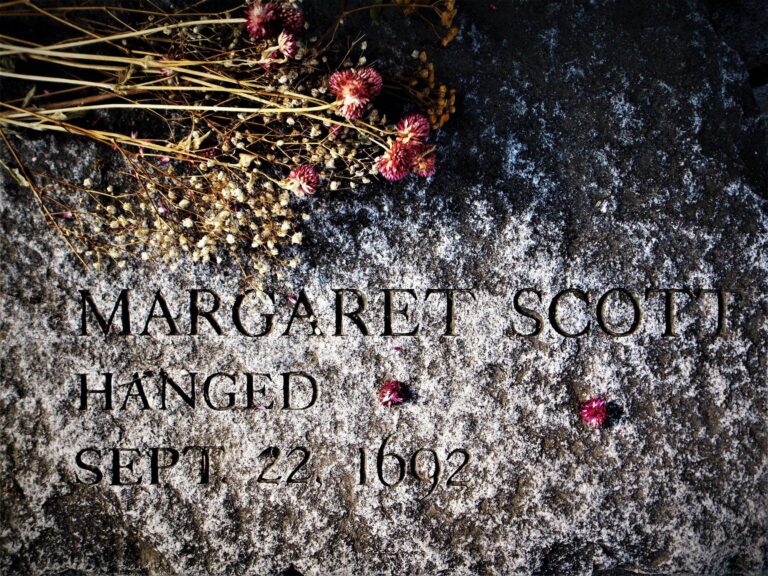
EXECUTED – Hanged September 22, 1692 — the final hangings
HER RECORDS – Mostly lost, no warrant, no examination transcript survives
A hard life in Rowley
Margaret Stevenson was born around 1615 to 1621, likely in England, and came to Massachusetts with her family. In 1642 she married Benjamin Scott, a struggling Rowley farmer. The couple had six children, but only three survived infancy, an ordinary, crushing grief for the time. When Benjamin died in 1671, he left Margaret a meager estate of less than seventy pounds. She was by then in her fifties, and for the next twenty years she watched that small sum slowly run dry.
The beggar of Rowley
As her money dwindled, Margaret Scott was reduced to begging her neighbors for food and help, and, as so often happened to poor older women, that need made her unpopular. Townspeople who turned her away sometimes claimed she answered with sharp words or muttered curses. It is the same grim pattern that doomed Sarah Good: an old, impoverished woman dependent on charity was exactly the sort of person a fearful community found easy to call a witch. When the trials came, several of the Rowley neighbors she had alienated made the trip to Salem to testify against her.
A case built on grudges and dead cattle
In early August 1692, a young woman named Mary Daniel claimed Margaret Scott’s specter had attacked and pinched her. Scott was arrested soon after and, so far as the surviving fragments show, examined and indicted. Her trial opened on September 15, and the testimony against her was the usual catalog of old resentments blamed, years later, on witchcraft:
- A man said that after Margaret asked him for corn and he made her wait, his oxen refused to pull the cart, only backward, never forward.
- Another claimed that after he refused her some firewood, two of his cattle were found dead in strange postures, one seemingly choked.
- Others recalled a neighbor who, before his death, had insisted he would never be well “so long as Margaret Scott lived.”
One after another, witnesses closed their testimony with the same refrain, that “in my heart” they believed Margaret Scott was a witch. On nothing more than that, she was found guilty and condemned.
“And ever since [I] had hard thoughts of this woman… and I do verily believe that she is a witch.”
— Thomas Nelson, testifying against Margaret Scott, from the court record, 1692
September 22, 1692
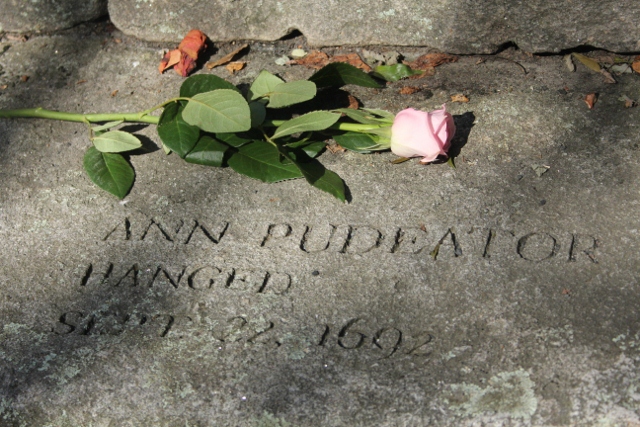
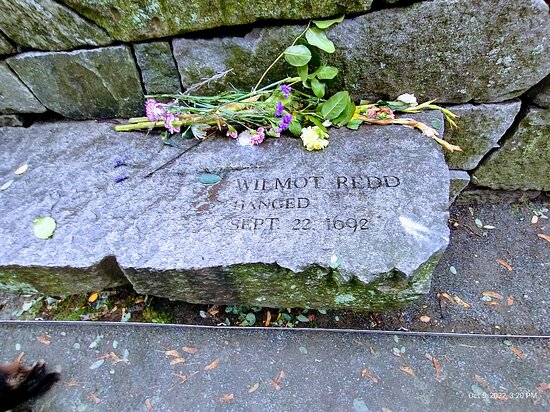
On September 22, 1692, Margaret Scott, the only person from Rowley caught in the hysteria, was taken by cart to Proctor’s Ledge with seven others, among them Mary Esty, Martha Corey, Ann Pudeator, Wilmot Redd, Alice Parker, Mary Parker, and Samuel Wardwell, in what became the last hangings of the Salem Witch Trials. The cart stuck fast on the hill, and the accusers cried that the devil was holding it back. As the bodies hung, Reverend Nicholas Noyes delivered his infamous sneer: “What a sad thing it is to see eight firebrands of hell hanging there.”
The victim Salem forgot
Margaret Scott’s erasure began almost at once. No relative came forward to clear her name when Massachusetts offered restitution in 1711, so her conviction was simply left standing, and she was passed over again in the state’s 1957 acknowledgment. It was not until October 31, 2001, more than three centuries later, that Massachusetts finally, formally exonerated her. Her grave, like so many of the victims’, has never been found.
THE VANISHING RECORDS
How her story was nearly lost forever
What truly sets Margaret Scott apart is how close her story came to disappearing entirely. Most of her case files, her arrest warrant, her examination, and her death warrant are simply gone. Some of Salem’s lost records may have been destroyed when a mob ransacked Governor Thomas Hutchinson’s house during the 1765 Stamp Act riots, scattering decades of historical papers. Hutchinson was writing a book about the history of Massachusetts. In 1840, some of the documents were transcribed in Thomas Gage’s book History of Rowley. In recent years, pieces of her case have quietly come to light, and even to market: her original indictment was auctioned in 2012, and one deposition against her sold for well over a hundred thousand dollars. A poor woman the court barely bothered to document has become, improbably, one of the rarest paper trails in Salem’s history.
WALK HER STORY
Hear Margaret Scott's story where it happened
Our historian-led 1692 Salem Historical Tour tells the true stories of Margaret Scott and the other victims on the very streets where the trials unfolded. Two hours, all ages, $35 adults / $10 kids.
Frequently asked questions
Margaret Scott was a poor, elderly widow from Rowley, Massachusetts, and one of the twenty people executed during the 1692 Salem Witch Trials. She was the only person from Rowley tried in the trials, and she was hanged on September 22, 1692.
Margaret Scott was an impoverished older widow who had been reduced to begging, which made her unpopular in Rowley — the same profile that doomed Sarah Good. Neighbors she had alienated testified against her, blaming old misfortunes like dead livestock and balky oxen on her supposed witchcraft, alongside the usual spectral accusations.
Most of the documents from Margaret Scott’s case — including her arrest warrant, examination transcript, and death warrant — have been lost over the centuries, making her one of the most obscure victims of the trials. Some Salem records may have been destroyed during the 1765 Stamp Act riots, when a mob ransacked Governor Thomas Hutchinson’s home.
Her surviving records had an unusually tangled history. A few were transcribed in an 1840 history of Rowley, others were rediscovered in a library archive, and some entered the private collector’s market: her original 1692 indictment was auctioned in 2012, and a deposition against her later sold for well over $100,000.
Margaret Scott was hanged on September 22, 1692, at Proctor’s Ledge in Salem, alongside Mary Esty, Martha Corey, Ann Pudeator, Wilmot Redd, and three others — the last group executed during the Salem Witch Trials. Her name was not officially cleared until 2001.
Sources & further reading
This article draws on the original 1692 court records and firsthand accounts. To read the primary sources yourself:
- Margaret Scott’s court records (SWP No. 119) — Salem Witch Trials Documentary Archive, University of Virginia.
- History of Rowley — By THOMAS GAGE.
- The Salem Witch Trials Documentary Archive and Transcription Project — the full collection of original court records and transcriptions from 1692.